If you do one thing for perimenopause, make it consistent exercise. Specifically, strength training. Nothing else — not supplements, not diet, not even most medical treatments — addresses as many perimenopausal symptoms at once. Yet most women either skip exercise entirely or do the wrong kind. This guide covers what the research actually shows and what to do about it.
This article is for informational purposes only and is not medical advice. Always consult a healthcare provider before starting a new exercise program, especially if you have existing health conditions.
Why exercise matters more in perimenopause than it did at 30
Three things shift during perimenopause that exercise specifically addresses:
- Accelerated muscle loss. Without intervention, women lose 3-8% of muscle mass per decade starting around age 30, and the loss accelerates after 40. Muscle is metabolically active tissue — losing it lowers your resting metabolic rate and drives weight gain even without dietary changes.
- Bone density loss. Estrogen has been protecting your bones. As it declines, bone density loss accelerates dramatically, especially in the first 5 years after menopause. According to the Endocrine Society, weight-bearing exercise is critical for preserving bone mass during this window.
- Insulin resistance. Estrogen helps maintain insulin sensitivity. As estrogen falls, cells become less responsive to insulin, blood sugar rises higher after meals, and the body stores more energy as fat. Strength training reverses insulin resistance more effectively than any other intervention.
Exercise directly addresses all three. No supplement does.
The strength training imperative
If you take only one thing from this article: start strength training. Two to three sessions weekly of resistance training is the single highest-leverage intervention for perimenopausal women.
What strength training does:
- Preserves and builds the muscle mass that drives metabolic rate
- Increases bone density (mechanical loading stimulates bone growth)
- Improves insulin sensitivity dramatically
- Stabilizes mood through endorphins and neurochemistry changes
- Reduces hot flash severity for many women
- Improves sleep quality
- Builds confidence and capability that compounds beyond fitness
What it looks like in practice: Two to three sessions weekly, 30-45 minutes each. Hit all major muscle groups (legs, back, chest, shoulders, arms, core). Focus on compound movements — squats, deadlifts (or hip hinges), rows, presses, pulls. Progressive overload matters: gradually increase weight, reps, or difficulty over weeks.
You don't need a gym. Resistance bands, dumbbells, kettlebells, or just bodyweight all work for beginners. Form matters more than weight — consider a few sessions with a trainer or following established programs if you're new.
Cardio: what's enough and what's too much
The current US guideline is 150 minutes per week of moderate-intensity aerobic activity OR 75 minutes of vigorous activity. This is the threshold associated with significant health benefits. The American College of Sports Medicine recommends spreading it across most days of the week.
Effective options:
- Brisk walking (3+ mph) — accessible, low-impact, sustainable
- Cycling — indoor or outdoor
- Swimming or water aerobics — excellent for joints
- Hiking
- Dance
- Elliptical
- Group fitness classes
The HIIT consideration: High-intensity interval training is effective and time-efficient, but moderation matters in perimenopause. 1-2 HIIT sessions weekly is beneficial. More than that, especially without adequate recovery, worsens cortisol dysregulation, fragments sleep, and can intensify hot flashes. If you've been chronically over-doing cardio and feeling worse, reducing volume and adding rest often helps.
Mobility, flexibility, and stress-reducing movement
Yoga, Pilates, and tai chi don't replace strength and cardio but they powerfully complement them. Specific evidence in perimenopause:
- Yoga has documented effects on hot flash frequency, sleep quality, mood symptoms, and joint pain. Even 2-3 sessions weekly produces measurable benefit.
- Pilates strengthens core and postural muscles that protect against back pain and pelvic floor issues that emerge during this transition.
- Tai chi improves balance (becoming more important to protect against falls as bone density declines) and reduces stress.
Adding 1-2 sessions of any of these to your week alongside strength and cardio creates a complete program.
How to match exercise to your worst symptoms
Different perimenopause symptoms respond to slightly different exercise emphasis:
- Hot flashes peak? Aerobic exercise 3+ sessions weekly of moderate intensity reduces frequency and severity by 30-40%.
- Sleep disruption? Morning exercise anchors circadian rhythm. Avoid intense exercise within 3 hours of bedtime.
- Mood swings or anxiety? Strength training has particularly strong evidence for anxiety reduction. Yoga also helps.
- Joint pain or stiffness? Counterintuitively, low-impact daily movement plus strength training improves joint pain more than rest.
- Brain fog? Aerobic exercise improves cognitive function within weeks. Walking outdoors combines movement with the cognitive benefits of nature exposure.
- Weight changes? Strength training plus protein matters more than cardio for body composition.
- Fatigue? Counterintuitively, regular exercise increases energy. Start gentle and build.
Common mistakes perimenopausal women make with exercise
- Doing only cardio, skipping strength. Preserves cardiovascular fitness but doesn't address the muscle loss driving metabolic decline.
- Chronic over-training without recovery. Worsens cortisol dysregulation in an already-elevated system.
- Severe caloric restriction combined with intense exercise. Accelerates muscle loss, slows metabolism, fragments sleep, worsens mood.
- Treating exercise as punishment for eating. This relationship rarely produces lasting change. Reframe exercise as health investment, not penance.
- Believing more is always better. 4 quality sessions weekly produces 90% of the benefit of 6 with much better adherence.
- Quitting when results don't appear in 2 weeks. Strength gains and body composition changes take 8-12 weeks to become visible. Stay consistent.
Building a sustainable routine
The exercise that works is the exercise you'll actually do for years. A sustainable weekly template:
- 2-3 strength training sessions (30-45 minutes each)
- 2-3 moderate cardio sessions (30+ minutes each) OR 8000+ steps daily
- 1-2 mobility/flexibility/stress-reducing sessions (yoga, Pilates, tai chi)
- 1 full rest day (recovery is when your body adapts)
Match this to your actual life. A busy week with 2 strength sessions and 4 walks is better than an ambitious week followed by burnout. Consistency over years matters more than perfection in any single month.
The Bottom Line
Exercise is the highest-leverage intervention for perimenopause symptoms — addressing muscle loss, bone density, metabolism, mood, sleep, hot flashes, and joint pain simultaneously. Strength training 2-3 times weekly is non-negotiable. Add 150 minutes weekly of moderate cardio and 1-2 mobility sessions. Match emphasis to your worst symptoms. Avoid the common mistakes of cardio-only, chronic over-training, and using exercise as punishment.
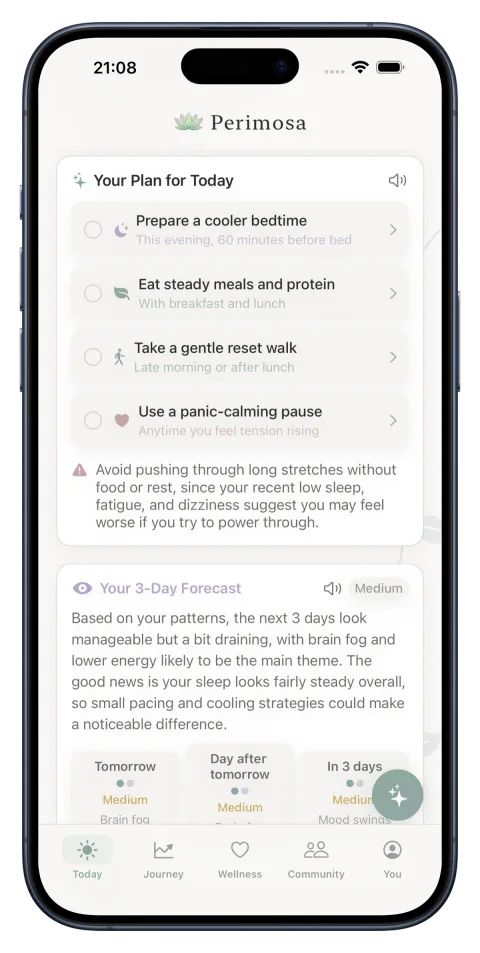
Track how exercise affects your symptoms in Perimosa over 8-12 weeks so you can see what's actually changing. The benefits compound over months, not days — but few interventions pay off as reliably or as broadly.