Perimenopause rage — sudden, intense anger that feels completely disproportionate to whatever triggered it — is a real, hormone-driven experience that affects a significant number of women during the menopausal transition. If you have found yourself snapping at your partner over something trivial, crying with frustration, or seething with an anger that seems to come from nowhere, you are not losing your mind. Your hormones are directly affecting your brain chemistry, and understanding why it happens is the first step toward managing it.
This article is for informational purposes only and is not medical advice. Always consult a healthcare provider about your symptoms.
Why does perimenopause make you angry?
To understand perimenopause rage, you need to understand what estrogen and progesterone actually do in your brain. These are not just reproductive hormones — they are powerful neuromodulators that influence how you think, feel, and react to the world.
Estrogen and Serotonin
Estrogen directly promotes serotonin production and helps maintain serotonin receptor sensitivity. Serotonin is the neurotransmitter most associated with emotional stability, patience, and the ability to regulate responses. When estrogen fluctuates rapidly during perimenopause, serotonin levels become unstable. Lower serotonin means a shorter fuse, less emotional buffer, and more intense reactions to minor provocations.
Progesterone and GABA
Progesterone enhances the activity of GABA, your brain's primary calming neurotransmitter. GABA literally inhibits neural activity — it slows things down, reduces excitability, and promotes a sense of calm. Progesterone is often the first hormone to decline during perimenopause, sometimes dropping significantly while estrogen remains relatively normal. Without adequate progesterone-driven GABA activity, your nervous system becomes more reactive, irritable, and easily overwhelmed.
The Amygdala Effect
Research using functional MRI has shown that fluctuating estrogen levels increase amygdala reactivity. The amygdala is your brain's threat-detection center — it processes fear, anger, and emotional responses. When estrogen is unstable, the amygdala responds more intensely to stimuli that would normally be filtered out or managed calmly. This means your brain is literally interpreting neutral situations as more threatening or annoying than they actually are.
Cortisol and the Stress Response
During perimenopause, cortisol (the stress hormone) levels tend to rise, partly because estrogen normally helps regulate the stress response. Higher baseline cortisol means you are already closer to your stress threshold before anything happens. Add sleep deprivation, physical discomfort from other symptoms, and the mental load of daily life, and the rage becomes almost inevitable.
What does perimenopause rage feel like?
Women describe perimenopause rage in remarkably consistent ways:
- A sudden, overwhelming wave of anger that seems to come from nowhere
- Disproportionate fury over minor inconveniences — a dish left in the sink, a slow driver, a mildly annoying comment
- A physical sensation of heat or tension that accompanies the anger
- Wanting to scream, throw things, or storm out of the room
- Feeling simultaneously enraged and horrified by the intensity of your own reaction
- Guilt and shame afterward, especially when the rage is directed at loved ones
- Episodes that may last minutes or simmer for hours
The guilt aspect is important. Many women feel deeply ashamed of their anger because it does not match their self-image or their usual emotional responses. Knowing that this is driven by measurable neurochemical changes — not a character flaw — can relieve some of that shame.
Rage vs. Irritability: What's the Difference?
Perimenopause can cause both irritability (a lower threshold for annoyance) and rage (intense, explosive anger). Irritability is more constant — a general sense of being on edge. Rage tends to come in episodes, often triggered by something specific but amplified far beyond what the trigger warrants.
Both are hormone-driven, but rage is more likely to occur when multiple factors converge: a hormonal dip, poor sleep the night before, high stress levels, and a trigger that hits just the wrong nerve. Understanding what leads up to rage episodes can help you anticipate and sometimes prevent them.
What makes perimenopause rage worse?
- Sleep deprivation. Even one night of poor sleep significantly reduces emotional regulation. Chronic insomnia, common in perimenopause, can make rage episodes much more frequent and intense.
- Unmanaged stress. Elevated cortisol lowers your threshold for emotional reactions. The more stressed you are, the smaller the trigger needed to set off rage.
- Blood sugar instability. Skipping meals or eating lots of refined carbohydrates causes blood sugar swings that directly affect mood and irritability.
- Alcohol. While it may seem to relieve stress in the moment, alcohol disrupts sleep, increases anxiety, and worsens mood instability.
- Feeling dismissed. When symptoms are not taken seriously by partners, family, or even healthcare providers, the frustration and anger intensify.
How do you manage perimenopause rage?
Immediate Strategies (When Rage Hits)
- Leave the room. Give yourself physical space before you say something you will regret. This is not avoidance — it is smart regulation.
- Cold water. Splashing cold water on your face or holding ice activates the dive reflex, which rapidly calms the nervous system.
- Box breathing. Inhale for 4 counts, hold for 4, exhale for 4, hold for 4. Repeat four times. This directly counteracts the fight-or-flight response.
- Physical movement. A brisk walk, even just 5 minutes, helps metabolize the stress hormones driving the rage.
- Name it. Saying to yourself (or out loud), "This is perimenopause rage" can create enough cognitive distance to prevent the anger from escalating.
Long-Term Strategies
- Prioritize sleep. This is arguably the most important intervention. Better sleep directly improves emotional regulation.
- Regular exercise. 30 minutes of moderate exercise most days reduces cortisol, improves serotonin, and builds stress resilience.
- Stable blood sugar. Eat regular meals with protein and healthy fats. Avoid going more than 3-4 hours without eating.
- Reduce alcohol. Even cutting from daily to a few times a week can meaningfully improve mood stability.
- Track your patterns. When you track mood, sleep, stress, and cycle phase together, you start to see what predicts rage episodes. Perimosa is built for exactly this kind of multi-symptom tracking, helping you spot the patterns that lead to your most difficult days. The app's daily plan adapts to your tracking, surfacing calming actions on the days your patterns predict a hard one.
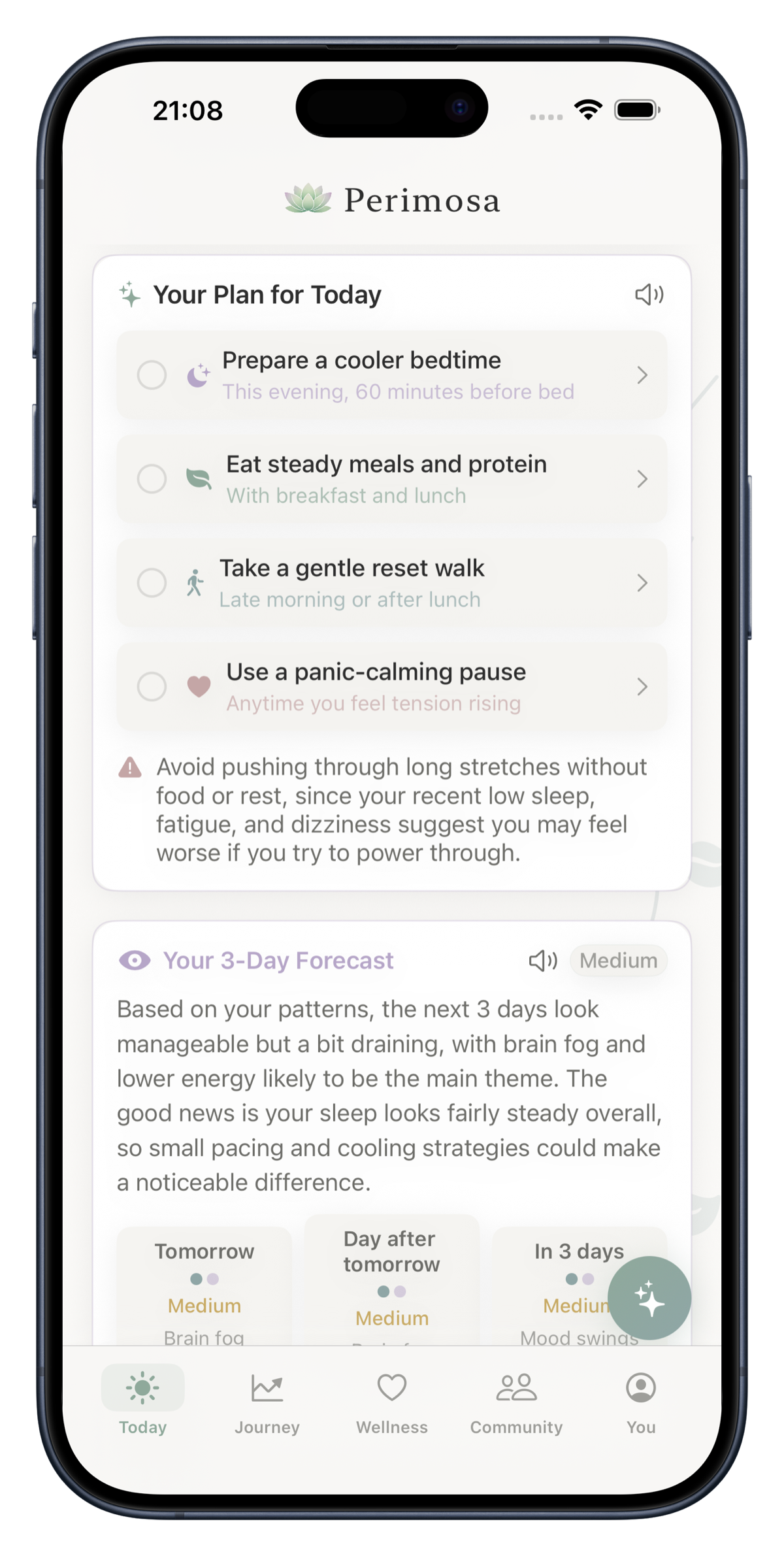
Your Plan for Today — calming actions tuned to the patterns Perimosa is seeing this week. - Communicate with loved ones. Letting your partner and family know that you are experiencing a hormonal change — not that you are angry at them — can reduce relationship strain and build a support system.
- Consider therapy. Cognitive behavioral therapy (CBT) is effective for managing anger and building emotional regulation skills, especially when combined with an understanding of the hormonal component.
- Discuss HRT with your doctor. For severe perimenopause rage, hormone therapy that stabilizes estrogen and progesterone can be very effective. This is a conversation to have with a knowledgeable healthcare provider.
When should you seek professional help for perimenopause rage?
While perimenopause rage is common, it should not be left unmanaged if it is significantly affecting your life. Seek professional support if:
- Rage episodes are damaging your relationships
- You feel unable to control your anger
- The anger is accompanied by persistent depression or anxiety
- You have thoughts of harming yourself or others
- The rage is affecting your ability to function at work or at home
Perimenopause Anger Treatment: What Actually Helps
Treatment for perimenopause rage is meaningful but not a single intervention. The most evidence-supported approaches:
- Hormone replacement therapy. Stabilizing estrogen via patch or gel often reduces rage episodes by 50-70% in women whose anger is clearly cyclic and hormone-driven. Especially effective when paired with bedtime micronized progesterone, which adds calming GABA-enhancing effects.
- SSRIs (selective serotonin reuptake inhibitors). Low-dose paroxetine, sertraline, or escitalopram can dampen the irritability + rage spike that comes with estrogen drops. Often used when HRT isn't appropriate or hasn't fully solved the issue.
- Cognitive behavioral therapy specifically for anger. Different from general CBT — anger-focused CBT teaches recognition of pre-rage warning signs (clenched jaw, heat in chest, tunnel vision) and interrupting the cascade before it explodes.
- Magnesium glycinate 300-400 mg at bedtime. Magnesium supports GABA function. Many women report reduced edge after 2-4 weeks of consistent use.
- Reducing the modifiable amplifiers: alcohol (worsens everything), caffeine excess, blood sugar swings from skipped meals, sleep deprivation. These don't cause rage but raise the floor on every bad day.
For severe rage that's affecting safety, mood stabilizers (lamotrigine, lithium) and short courses of benzodiazepines are sometimes used — but these are second-line specialist decisions, not starting points.
Does Perimenopause Make You Angry — or Does It Make You FEEL Angry?
An important distinction: perimenopause doesn't manufacture anger out of nothing. It does two things to existing anger:
- It lowers your threshold for what triggers an angry response. Things you would have shrugged off six months ago now feel disproportionately enraging.
- It amplifies physical intensity. The neurochemistry of estrogen withdrawal sharpens the body's anger response — the heart racing, the heat, the tunnel vision are stronger than before.
So if you're newly furious about things that were tolerable before, this isn't a personality change — it's a calibration change. Many women describe it as "I'm not angrier than I was, but my body reacts as if I am." Understanding this distinction is itself therapeutic.
"Does Perimenopause Make You Feel Crazy?" — The Real Answer
This is one of the most-searched perimenopause questions, and the answer matters because shame and isolation make symptoms worse. The honest answer: yes, it can feel that way — but no, you aren't actually losing your mind.
What women describe as "feeling crazy" during perimenopause is almost always a constellation of:
- Mood swings that feel out of proportion to triggers
- Brain fog that makes you doubt your competence
- Sleep deprivation that amplifies everything
- Anxiety that comes in waves with no clear cause
- The specific perimenopause-rage spike
- A sense of not recognizing yourself
This is real, validated by research, and improves significantly with treatment. The label "crazy" is wrong — but the experience of feeling that way is universal enough that nearly every woman in a r/Perimenopause thread can identify with it.
The Bottom Line
Perimenopause rage is not a personal failing. It is the result of measurable neurochemical changes caused by hormonal fluctuations. Understanding the science does not make the anger disappear, but it gives you context, reduces shame, and opens the door to effective management strategies. You are not crazy. You are not a bad person. Your brain chemistry is in flux, and there are real things you can do about it.