Searching for the best perimenopause app reveals a confusing landscape. App store rankings don't reflect quality. Marketing claims overlap. Most "best of" articles are paid placements. This is an honest comparison from someone who built a perimenopause app — including the parts where competitors do things better than we do.
Full disclosure: this article is published by Perimosa. We've tried to compare honestly, including where competitors outperform us. The right app is the one that fits YOUR needs, not the one with the biggest marketing budget.
What to look for in a perimenopause app
Before comparing specific apps, know what actually matters during this transition:
- Symptom tracking depth. 30+ recognized perimenopause symptoms means a good app should let you log most of them. Not just "mood" but specific patterns like rage, anxiety, brain fog, hot flashes, joint pain, vaginal symptoms, sleep quality.
- Cycle tracking with phase awareness. Symptoms often cluster in specific cycle phases. The app should show you how your symptoms map to where you are in your cycle.
- Pattern detection. Tracking is only valuable if you can see patterns. Look for AI or analytics that surface insights you'd otherwise miss.
- Daily check-in friction. If logging takes more than 30-60 seconds, you'll quit within weeks. The best apps make daily check-in fast.
- Doctor-ready reports. The point of tracking is informed healthcare conversations. Can you generate a clean summary to share with your doctor?
- Privacy. Health data is sensitive. Check whether your data is sold, anonymized for research, or kept private.
- Pricing transparency. Free with optional Pro? Subscription only? One-time purchase? Knowing the actual cost matters.
- Sustainability. The app you'll use for 5-10 years (the typical perimenopause duration) needs to keep working long-term.
The apps people actually compare
Caria
What it is: A perimenopause and menopause app built around Cognitive Behavioral Therapy (CBT) for symptom management, particularly hot flashes. UK-based, founded by Caroline Cellard.
What it does well:
- Strong CBT-based programs with structured 4-week courses for hot flashes, sleep, anxiety
- Evidence-based content drawing on UK menopause research
- Clean, friendly UI
- Good for women who respond to structured behavioral interventions
Where it falls short:
- Symptom tracking is limited compared to dedicated trackers
- Less daily check-in focus, more programmatic
- Most features behind paywall
- No deep AI pattern recognition
- Not specifically optimized for US users
Best for: Women who want structured behavioral therapy programs and respond well to CBT-style learning.
Balance
What it is: A menopause app from UK menopause specialist Dr. Louise Newson, heavily focused on HRT management and education.
What it does well:
- Strong HRT-related content and tracking
- Connection to Dr. Newson's clinical expertise
- Detailed symptom questionnaires
- Good for UK women in the NHS system
- Free core features with paid premium tier
Where it falls short:
- Heavily UK-centric — US healthcare terminology differs
- HRT focus may not match every woman's needs
- Less daily-check-in friendly than dedicated trackers
- Pattern detection is basic
- Some content reads as marketing for paid telehealth services
Best for: UK-based women considering or on HRT who want clinical-style content and HRT tracking.
Flo
What it is: The most popular period tracking app globally, expanding into menopause features.
What it does well:
- Massive user base means polished product
- Strong period and ovulation tracking
- Free tier is functional
- Good educational content
- Familiar interface for women who've used it for years
Where it falls short:
- Designed primarily for fertility and period tracking, not menopause
- Menopause features feel bolted on rather than purpose-built
- Limited perimenopause-specific symptom depth
- Data privacy concerns have surfaced over the years (research before deciding)
- Aggressive paid feature pushing
Best for: Women already using Flo for periods who want basic perimenopause tracking without switching apps.
Clue
What it is: Berlin-based, science-focused period tracking app that's added menopause features.
What it does well:
- Strong commitment to science-based content (works with researchers)
- Better data privacy track record than Flo
- Clean, minimal UI
- Inclusive language and product design
- Predictable subscription model
Where it falls short:
- Like Flo, designed primarily for periods/fertility
- Menopause features less developed
- Limited symptom variety for the full perimenopause spectrum
- No AI pattern detection
Best for: Women who prefer science-focused, privacy-respecting period tracking with light perimenopause features.
Perimosa
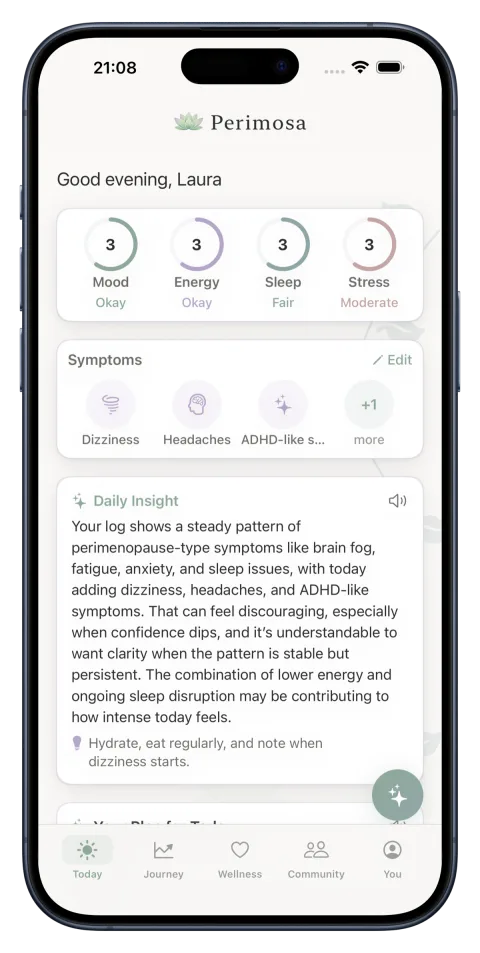
What it is: Purpose-built perimenopause tracker with AI pattern recognition, 30+ symptoms, and doctor-ready reports.
What it does well:
- 30+ perimenopause-specific symptoms (not generic mood/period categories)
- 30-second daily check-ins designed for sustainability
- AI pattern recognition reveals what triggers and improves your symptoms
- Doctor-ready report you can hand to your provider
- Free core features (Pro is optional, not required for tracking)
- Privacy-first design — your data is yours
- Cycle phase awareness — see symptoms mapped to your cycle
- Works through all 4 stages from early perimenopause to postmenopause
Where we fall short:
- Newer than Flo or Clue — smaller user base and less brand recognition
- No built-in CBT program like Caria offers
- No HRT tracking depth like Balance
- Currently iOS-only (Android coming soon)
- Less content depth on individual topics than blog-heavy apps
Best for: Women in perimenopause who want comprehensive symptom tracking, AI insights, and a doctor-ready report. The "I want to actually understand what's happening to me" use case.
Quick comparison table
| Feature | Caria | Balance | Flo | Clue | Perimosa |
|---|---|---|---|---|---|
| Perimenopause-specific design | Yes | Yes | No | No | Yes |
| 30+ symptom tracking | Limited | Yes | Limited | Limited | Yes |
| AI pattern recognition | No | Basic | Basic | No | Yes |
| CBT-based programs | Yes | No | No | No | No |
| HRT-focused content | No | Yes | No | No | Educational only |
| Doctor-ready report | No | Yes | No | No | Yes |
| Cycle + symptom map | Limited | Limited | Yes | Yes | Yes |
| Free tier | Limited | Yes | Yes | Yes | Yes |
| Privacy-first | Yes | Yes | Mixed history | Yes | Yes |
Flo vs Clue: which handles perimenopause better?
This is the comparison people search for most often, because these are the two apps women are most likely to already have on their phone. Both were built for periods and fertility, and both have added menopause features since — so the honest answer is that the choice between them matters less than whether either is the right tool for where you are now.
Where they differ:
- Privacy. Clue is based in Berlin and operates under GDPR, and has generally been regarded as the more conservative of the two on data handling. Flo has faced more public scrutiny on this over the years. If your reproductive health data matters to you — and after recent years it reasonably might — this is the difference worth weighing most.
- Content. Clue leans academic and works with researchers; Flo leans accessible and consumer-friendly. Which you prefer is mostly temperament.
- Prediction. Flo's cycle predictions are strong on regular cycles, which is what it was built for. That strength becomes a limitation in perimenopause, when the premise of a predictable cycle stops holding.
- Interface. Clue is minimal and quiet. Flo is busier and pushes its paid tier harder.
Where they are the same, and where it matters: both treat perimenopause as an extension of period tracking rather than a distinct phase. Symptom lists stay oriented toward cycle and fertility, and neither is built to answer the question that actually preoccupies women in the transition — not when is my next period, but why do I feel like this, and what is making it worse.
If you are still cycling regularly and mainly want period prediction, either is a reasonable choice and Clue is the one we would pick on privacy grounds. If your cycles have become unpredictable and the thing you want explained is the symptoms, a purpose-built perimenopause tracker will get you further than either.
How to choose: match the app to your priority
The "best" depends on what you most need help with right now:
If you want to understand YOUR specific symptom patterns
Perimosa is purpose-built for this. The AI surfaces patterns you'd miss with manual tracking — like sleep quality predicting next-day brain fog, or specific foods triggering hot flashes 3 hours later. Generic period trackers can't do this depth.
If you want structured behavioral therapy programs
Caria's CBT-based programs for hot flashes, sleep, and anxiety are the strongest in this niche. Limited tracking depth but strong behavioral content.
If you're considering or managing HRT
Balance focuses heavily on HRT — tracking, education, and content from Dr. Newson. If HRT decisions dominate your concerns, this depth may matter to you.
If you're still cycling regularly and want basic perimenopause add-ons
Flo or Clue may suffice if you're already using one and don't want to switch apps. They lack depth but cover the basics.
If you want a doctor-ready report
Both Balance and Perimosa generate provider-shareable reports. Perimosa's includes AI-detected patterns; Balance's leans more clinical/HRT-focused.
What matters more than the app
Honest reality: no app fixes perimenopause. The best tracker can't replace finding a menopause-trained doctor, making lifestyle changes that move the needle (strength training, sleep, alcohol reduction), or considering medical treatment when appropriate.
What an app DOES do: it shows you patterns that would otherwise stay invisible across months. It gives you data to bring to doctor visits instead of vague complaints. It validates that what you're experiencing is real and patterned, not random or imaginary. The right app supports the work; it doesn't replace it.
Switching costs and lock-in
You'll likely use whatever app you choose for years. Consider:
- Data export: Can you get your tracking data out if you switch apps later?
- Subscription pricing: What does the long-term cost look like? Some apps are cheap upfront but expensive over 5 years.
- Platform availability: If you switch from iPhone to Android (or vice versa), does the app come with you?
- Privacy policy: What happens to your data if the company gets acquired or shuts down?
The Bottom Line
The best perimenopause app is the one that fits how YOU need to navigate this transition. Caria for CBT-based behavioral therapy. Balance for HRT-focused content. Flo or Clue for women already using them for periods. Perimosa for purpose-built daily tracking with AI pattern recognition and doctor-ready reports.
Try a free tier before committing to any subscription. Use the app for 2-3 weeks consistently before judging — daily tracking only reveals patterns over time. And remember: no app replaces finding a good doctor, making real lifestyle changes, and considering medical treatment when symptoms warrant. The right app supports the work — it doesn't replace it.