Search "perimenopause natural remedies" and you'll find dozens of articles promising fast relief from herbs, oils, and supplements. The truth is messier. Some natural approaches genuinely work. Many don't. The supplement industry profits from your confusion. This guide cuts through the noise with what the research actually supports — and what to skip.
This article is for informational purposes only and is not medical advice. Always consult a healthcare provider about supplements and treatments, especially if you take other medications.
Why "natural" doesn't mean "effective"
The word "natural" gets attached to everything from black cohosh to magnesium oxide to wild yam cream. The dietary supplement industry in the United States is largely unregulated — products don't need to prove efficacy before going to market. According to the National Center for Complementary and Integrative Health (NCCIH), many supplements marketed for menopause have weak or contradictory evidence behind them. Knowing what's been actually studied matters more than what sounds appealing on the label.
The interventions below are organized by strength of evidence, not by popularity.
Tier 1: Strongest Evidence (Do These First)
Strength training
Resistance training 2-3 times weekly has the strongest overall evidence base for perimenopause. It preserves the muscle mass that declines accelerated by 40 (which drives metabolic decline more than hormones themselves), protects bone density as estrogen falls, improves insulin sensitivity, stabilizes mood, and reduces hot flash severity. The NIA consistently recommends resistance training as foundational for women over 40.
You don't need a gym. Two 30-40 minute sessions per week with bodyweight, resistance bands, or dumbbells produces measurable results within 12 weeks. Focus on compound movements: squats, deadlifts, rows, presses, pulls. Progressive overload (gradually increasing weight or reps over time) matters more than which specific exercise.
Eliminating or dramatically reducing alcohol
If you do one thing, do this. Alcohol — even moderate amounts — disrupts the second half of sleep, intensifies hot flashes, worsens next-day mood, drives belly fat, and increases inflammation. For most perimenopausal women, eliminating alcohol within 3 hours of bedtime produces dramatic improvement within a week. Some find that cutting alcohol entirely is the single highest-leverage change they made through the transition.
Mediterranean-style eating
The Mediterranean diet has consistent evidence for cardiovascular health, metabolic protection, mood support, and inflammation reduction — all of which become priorities during perimenopause. Emphasis on vegetables, fruit, legumes, whole grains, fish, olive oil, and nuts. Limited red meat, ultra-processed foods, and refined sugar. Unlike restrictive diets, it's sustainable for life. According to the USDA Dietary Guidelines and decades of research from the PREDIMED trial onward, this pattern outperforms more aggressive approaches in long-term studies.
Sleep optimization
Most perimenopausal symptoms worsen with poor sleep, and most natural interventions work better when sleep is protected. The foundations: bedroom temperature 60-67°F, moisture-wicking bedding, no alcohol within 3 hours of bed, no caffeine after noon, consistent bedtime, 30-60 minute wind-down ritual, no screens in bed. Cognitive Behavioral Therapy for Insomnia (CBT-I) has stronger long-term evidence than any sleep medication. The NIA and Sleep Foundation both highlight sleep as a foundational lever.
Tier 2: Solid Evidence for Specific Symptoms
Magnesium glycinate
For sleep, anxiety, muscle tension, headaches, and constipation — magnesium has solid evidence. Many perimenopausal women are mildly deficient. The form matters: magnesium glycinate is well-absorbed and gentle on digestion. Magnesium oxide (often used in cheap supplements) is poorly absorbed. Typical dose: 200-400mg in the evening. Allow 4-6 weeks of consistent use before judging effect. The NIH Office of Dietary Supplements has a detailed fact sheet on safe dosing.
Vitamin D (after testing your level)
Vitamin D deficiency mimics and worsens many perimenopause symptoms: fatigue, low mood, brain fog, immune dysfunction. Get your level tested first — the optimal range is 40-60 ng/mL. Most women need 2000-4000 IU daily to reach that range. Don't guess; test. The NIH Office of Dietary Supplements vitamin D fact sheet explains optimal levels and how to dose.
Omega-3 fatty acids (EPA + DHA)
Reduce inflammation, support mood, may modestly reduce hot flash frequency, and protect cardiovascular health (especially important as estrogen-mediated protection declines). Target 1000-2000mg combined EPA/DHA daily from quality fish oil or algae. Look for third-party tested products to avoid contamination.
Black cohosh (for hot flashes only)
The most-studied herbal supplement for vasomotor symptoms. Quality evidence suggests it reduces hot flash frequency by 25-30% in some women. It's not estrogenic — it works through different pathways including serotonin. Effects appear after 4-8 weeks of consistent use. Quality varies dramatically by brand; choose products standardized to 27-deoxyactein content. Not appropriate for women with liver disease. Discontinue if you notice unusual fatigue or jaundice.
Stress management practice
Cortisol dysregulation amplifies almost every perimenopausal symptom. Daily stress practices — 10 minutes of breathing exercises, meditation, yoga, time in nature, or therapy — reduce baseline cortisol over weeks. The intervention type matters less than consistency. Apps like Calm and Insight Timer make this easier to maintain.
Tier 3: Mixed Evidence (Try Carefully)
Soy isoflavones
Helps some women significantly, others not at all. Genetic variation in how women metabolize soy (specifically whether they produce equol) explains much of the variation. Food sources (tofu, tempeh, edamame, soy milk) are well-tolerated. Concentrated supplements should be discussed with your doctor, especially if you have a history of estrogen-sensitive cancers.
Sage extract
Modest evidence for reducing sweating specifically. Available as tea or capsules. Less side effect risk than many alternatives.
Probiotics
The gut microbiome shifts during perimenopause, and some women experience improved digestive symptoms, mood, and immune function with consistent probiotic use. Multi-strain products with documented strains (look for the strain numbers, not just the species) are more reliable than vague "probiotic blend" products.
Tier 4: Skip or Be Skeptical
Wild yam cream
Despite marketing claims, wild yam doesn't convert to progesterone in the body. Whatever benefit users experience is likely placebo or from the moisturizing carrier.
"Menopause complex" supplement blends
Products with 10-20 ingredients at minimal doses each almost universally underperform single-ingredient products at therapeutic doses. The marketing implies that throwing everything at the problem is more comprehensive, but the actual amounts of each ingredient are typically too low to have an effect.
Maca
Heavily marketed but evidence for menopausal symptom relief is weak and inconsistent across studies. Not harmful, but rarely worth the cost.
Evening primrose oil
Despite decades of marketing for women's health, robust evidence for menopausal symptom relief is lacking. Some women report benefit but trials have been disappointing.
Compounded "bioidentical" hormones marketed as supplements
These bypass FDA regulation that applies to pharmaceutical HRT. Safety and dosing inconsistencies are real risks. If hormone therapy is appropriate for you, regulated HRT through a doctor is safer than compounded products.
How to test what's actually working for YOUR body
The supplement industry profits from confusion. Many women try 5-6 interventions simultaneously, see modest improvement, and credit the wrong one — wasting money on placebos for years. Structured testing solves this.
The approach:
- Pick one intervention at a time
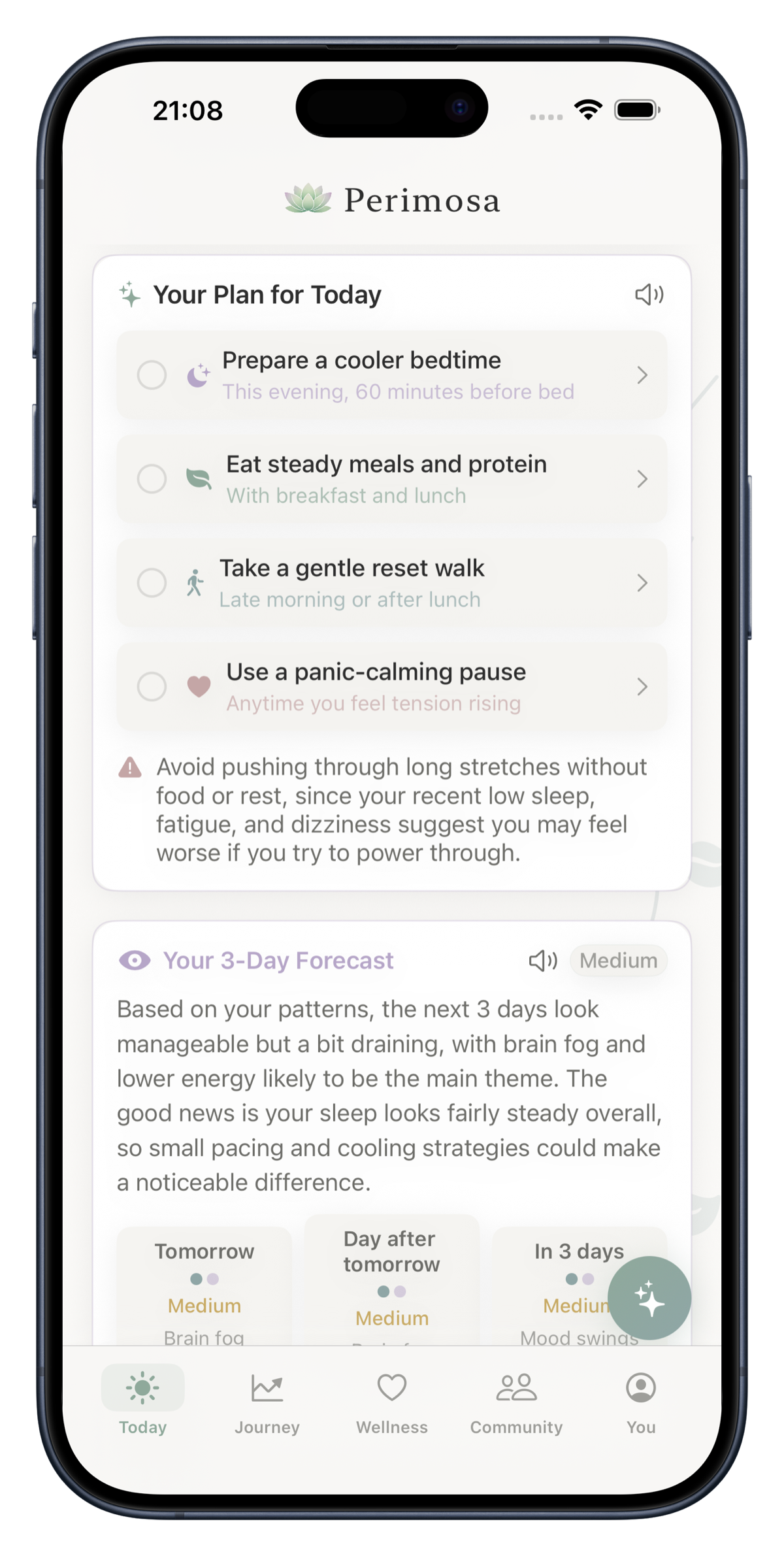
- Track your target symptoms in Perimosa for 2 weeks BEFORE starting (establish baseline)
- Add the intervention. Stay consistent for 6-8 weeks
- Compare tracked symptoms before vs after
- If meaningful improvement, continue. If not, stop and try the next thing
This is the difference between guessing and knowing. The same supplement that helps one woman dramatically may do nothing for another. Personal n=1 experimentation with measurement is more valuable than any general guide.
Combining natural remedies with medical treatment
"Natural" and "medical" aren't opposites. Many women benefit most from combining lifestyle foundations with targeted medical treatment when severity warrants. HRT and non-hormonal medications work better when sleep, nutrition, exercise, and stress management are in place — not as replacements for them. Per The Menopause Society's 2022 Hormone Therapy Position Statement, lifestyle interventions are a recommended foundation alongside medical treatment options. The goal isn't natural-purity. It's actual quality of life through this transition.
The Bottom Line
The natural remedies with the strongest evidence are unglamorous: strength training, sleep optimization, Mediterranean eating, reducing alcohol, and stress management. Magnesium glycinate, vitamin D (after testing), and omega-3s are worth adding. Black cohosh for hot flashes specifically. Skip the multi-ingredient "menopause complex" blends, wild yam cream, and maca. Test interventions one at a time with consistent symptom tracking, give each 6-8 weeks before judging, and don't let the supplement industry waste your money.
If lifestyle and natural approaches reduce symptoms enough that quality of life is good, you're done. If not, talk to a menopause-trained doctor about adding HRT or non-hormonal medications on top of your natural foundation — these aren't mutually exclusive.