You're eating the same. You're exercising the same. But the scale is climbing, your clothes are tighter, and your body looks unfamiliar in the mirror. This is one of the most demoralizing aspects of perimenopause — and one of the most misunderstood. Weight gain during perimenopause isn't lack of willpower or "letting yourself go." It's a complex hormonal, metabolic, and lifestyle interaction that requires a different strategy than what worked at 30. This guide covers why it happens and what actually moves the needle.
This article is for informational purposes only and is not medical advice. Always consult a healthcare provider about your specific situation.
The reality of perimenopause weight gain
According to data from the SWAN study and other longitudinal research, women gain an average of 5-10 pounds during the menopausal transition — but the distribution matters more than the total. Pre-menopausal women under estrogen's influence tend to store fat in the hips, thighs, and buttocks (the classic "pear" shape). As estrogen declines, fat storage shifts toward the abdomen and visceral compartment (around organs).
Many women experience significant body recomposition without dramatic scale changes: less muscle mass, more abdominal fat, similar or slightly higher scale weight, dramatically different appearance and clothing fit. The scale lies during perimenopause — waist circumference, how clothes fit, and body composition matter more.
According to the Menopause Society, this pattern affects roughly 60% of women during the transition. It's typical biology, not personal failure.
Why this is happening: the five drivers
1. Declining estrogen shifts fat storage
Estrogen influences where the body stores fat. As estrogen declines, the body's fat distribution shifts from the lower body (subcutaneous fat) toward the abdomen and around organs (visceral fat). Visceral fat is metabolically dangerous — it's strongly linked to cardiovascular disease, type 2 diabetes, insulin resistance, and inflammation. This isn't just an aesthetic issue; it's a health risk that accelerates during the transition.
2. Accelerated muscle loss
Women lose muscle mass faster after age 40, and the decline accelerates after menopause. Without strength training intervention, women lose 3-8% of muscle mass per decade. Muscle is metabolically active tissue — each pound burns about 6-10 calories daily at rest. Losing 5-10 pounds of muscle over a decade noticeably lowers resting metabolic rate. This is the single biggest driver of "I'm eating less and gaining more" — your body needs less food than it did at 30 because it has less metabolically active tissue.
3. Insulin resistance increases
Estrogen helps maintain insulin sensitivity. As estrogen declines, cells become less responsive to insulin, blood sugar rises higher after meals, and the body stores more energy as fat — preferentially in the abdomen. Insulin resistance also increases hunger and cravings for carbohydrates. This is why carbs and sugar that didn't bother you at 30 produce noticeable belly fat at 45.
4. Sleep disruption affects hunger hormones
Night sweats and 3am wake-ups fragment sleep, and chronic poor sleep dramatically affects hunger and satiety hormones. Sleep deprivation increases ghrelin (the hunger hormone) and decreases leptin (the satiety hormone). The result: increased appetite, especially for high-calorie comfort foods, and reduced sense of fullness. This is a direct biological mechanism, not lack of discipline.
5. Cortisol patterns shift
Perimenopause is accompanied by HPA-axis dysregulation in many women. Cortisol patterns shift, often producing the wired-tired evening pattern. Chronically elevated cortisol drives visceral fat accumulation, increases sugar cravings, disrupts sleep further, and creates a vicious cycle.
Why what worked at 30 doesn't work at 45
The strategies that produced quick weight loss in your 20s and 30s often backfire in perimenopause:
- Severe caloric restriction accelerates muscle loss, lowers metabolic rate further, triggers compensatory hunger, and produces rebound weight gain.
- Hours of cardio raises cortisol, fragments sleep, and doesn't address the underlying muscle loss driving metabolic decline.
- Low-fat diets often increase refined carb intake, worsening insulin resistance.
- Intermittent fasting with long windows works for some perimenopausal women but spikes cortisol and worsens sleep in others.
- "Detoxes" and cleanses do nothing real and often create unhealthy relationships with food.
The body's physiology has changed. The strategy needs to change with it.
What actually works: the evidence-based strategy
Strength training (non-negotiable)
The single highest-leverage intervention for perimenopausal body composition. Two to three resistance training sessions weekly preserves and rebuilds the muscle mass driving metabolic rate. Strength training specifically reduces visceral fat — even without overall weight loss. Within 12 weeks of consistent training, most women see measurable changes in body composition and how clothes fit.
What to do: 2-3 sessions weekly, 30-45 minutes each. Focus on compound movements: squats, deadlifts (or hip hinges), rows, presses, pulls. Progressive overload (gradually increasing weight or reps) drives ongoing gains. Bodyweight, resistance bands, dumbbells, machines, or gym — whatever you'll actually do consistently.
Adequate protein at every meal
Protein needs rise during perimenopause. Target 100g+ daily (1.0-1.2g per kg body weight) distributed across meals (25-30g per meal). Adequate protein:
- Supports muscle preservation and growth
- Improves satiety and reduces snacking
- Stabilizes blood sugar
- Has the highest thermic effect of any macronutrient (more calories burned digesting)
Most women under-eat protein at breakfast specifically — prioritize it there. Sources: Greek yogurt, eggs, cottage cheese, fish, poultry, lean meat, beans, lentils, tofu, edamame.
Reduce or eliminate alcohol
Alcohol drives belly fat through multiple mechanisms: empty calories, disrupted sleep, worsened insulin sensitivity, increased cortisol, and reduced inhibition leading to overeating. Cutting alcohol is often the single highest-leverage dietary change. Many women report noticeable waist circumference improvement within 4-6 weeks of eliminating alcohol entirely.
Prioritize sleep ferociously
Sleep affects body composition more than people realize. Poor sleep drives visceral fat through cortisol, increases ghrelin, decreases leptin, and reduces willpower for healthy choices the next day. Optimizing sleep often produces visible weight changes within 4-6 weeks. Address night sweats directly if they're fragmenting sleep — treating the underlying vasomotor symptoms often resolves weight challenges downstream.
Mediterranean-style eating
The Mediterranean dietary pattern has the strongest evidence for cardiovascular and metabolic health during the menopausal transition. Per the USDA Dietary Guidelines, this pattern emphasizes:
- Vegetables and fruit (8+ servings daily)
- Legumes and beans
- Whole grains
- Fish 2-3 times weekly
- Olive oil as primary fat
- Nuts and seeds
- Limited red meat and ultra-processed foods
Unlike restrictive diets, Mediterranean eating is sustainable for life and addresses both weight and long-term cardiovascular risk.
Manage stress and cortisol
Daily stress practices — meditation, breathing exercises, yoga, time outdoors, social connection — reduce chronic cortisol elevation that drives visceral fat. Specific evidence for yoga in particular for both stress reduction and abdominal fat. Even 10-15 minutes daily produces measurable cortisol pattern improvement over weeks.
Walking and NEAT (non-exercise activity)
Beyond formal exercise, daily movement matters significantly. Walking 8,000-10,000 steps daily, taking stairs, standing more, and reducing sedentary periods contribute meaningfully to body composition without the cortisol cost of intense cardio. Many women find post-meal walks (10-15 minutes after lunch and dinner) improve insulin sensitivity measurably.
What to measure (and what to ignore)
The scale alone is a poor measure during perimenopause because body recomposition (less muscle, more fat at similar weight) can happen invisibly. Better metrics:
- Waist circumference at navel (monthly). Over 35 inches indicates increased health risk.
- How specific clothes fit. Favorite jeans, a specific dress.
- Photos in the same lighting and clothing (monthly).
- Grip strength if you have a dynamometer. Tracks muscle quality.
- Energy levels and how you feel. Subjective but valuable.
- Periodic DEXA or InBody scans for precise body composition.
- Blood markers: A1c, lipid panel, inflammatory markers if available.
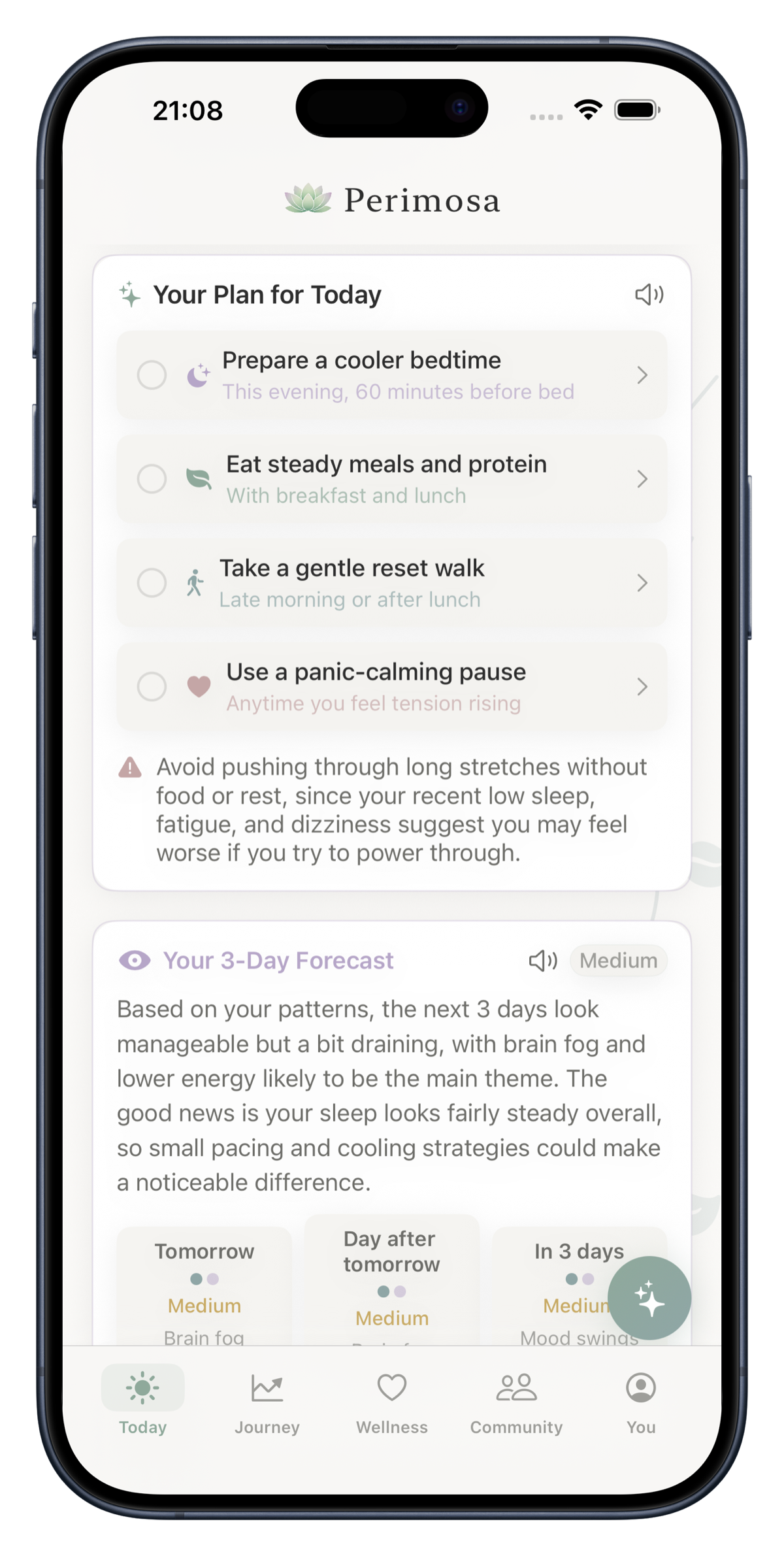
Tracking these in Perimosa monthly shows real changes over 3-6 months that the daily scale obscures with normal water weight fluctuations.
Medical considerations worth knowing
HRT and weight
Research consistently shows HRT doesn't cause weight gain. The Women's Health Initiative and multiple subsequent studies confirm this. In fact, women on HRT typically have less abdominal fat accumulation than those not on HRT — because HRT helps maintain insulin sensitivity and metabolic rate. The weight gain blamed on HRT is actually the weight gain of menopause itself. If anything, HRT may modestly help body composition.
Insulin resistance evaluation
If you're struggling with belly fat despite consistent effort, request fasting insulin and fasting glucose tests (not just A1c). Insulin resistance can be present years before A1c rises into diabetic range. Treatment options include metformin (which has emerging evidence for cardiometabolic protection in perimenopausal women) and intensive lifestyle changes.
Thyroid evaluation
Hypothyroidism frequently emerges during perimenopause and causes weight gain, fatigue, and mood symptoms. Request a full thyroid panel (TSH, free T3, free T4, TPO antibodies), not just TSH.
GLP-1 medications (Ozempic, Wegovy, Mounjaro)
These medications are increasingly used for weight management. Effectiveness in perimenopausal women specifically is being studied. Considerations include cost, insurance coverage, side effects, the question of long-term use, and concerns about muscle loss with rapid weight reduction. Strength training and adequate protein become even more important when on GLP-1s to prevent excessive muscle loss. Discuss with a doctor familiar with both menopause and GLP-1 prescribing.
Setting realistic expectations
Sustainable weight management during perimenopause looks different from quick weight loss at 25. Realistic outcomes with consistent effort over 6-12 months:
- 1-2 inches off waist circumference
- 5-10 pounds gradual weight loss (slower if simultaneously building muscle)
- Improved energy and sleep
- Better insulin sensitivity markers
- Visible body composition improvement
- Reduced inflammation
Crash diet promises of 20+ pounds in 8 weeks during perimenopause almost universally backfire. Consistent moderate effort over 12+ months produces lasting results.
The Bottom Line
Perimenopause weight gain affects about 60% of women and reflects real hormonal and metabolic changes — not lack of willpower. The drivers are estrogen-driven fat redistribution, accelerated muscle loss, insulin resistance, sleep disruption affecting hunger hormones, and cortisol patterns. Strategies from your 20s and 30s often backfire. What works: strength training 2-3 times weekly, 100g+ protein daily, eliminating alcohol, prioritizing sleep, Mediterranean eating, stress management, and walking 8,000+ steps daily.
Measure waist circumference, how clothes fit, energy, and body composition rather than relying on the scale. Track interventions in Perimosa to see what's actually working over 3-6 months. Expect gradual progress, not dramatic transformation. HRT doesn't cause weight gain and may help. If you're plateaued despite consistent effort, get insulin resistance and thyroid function evaluated.