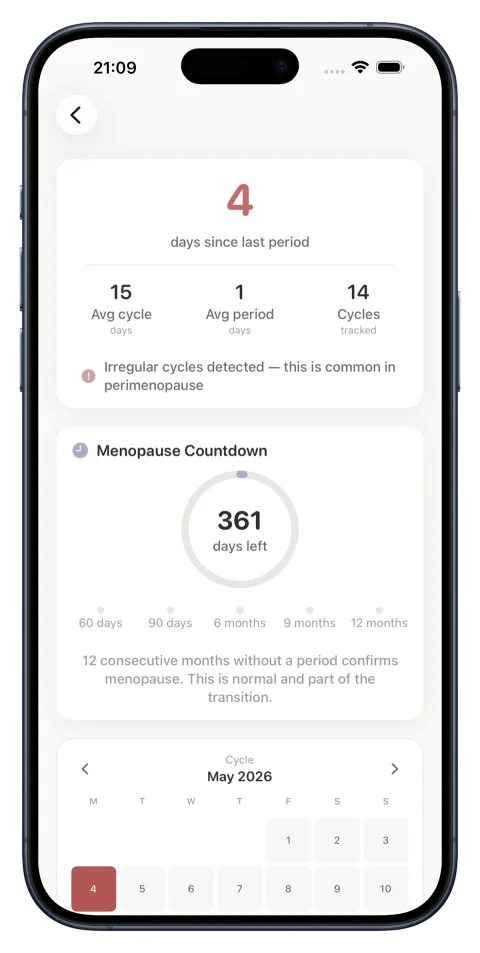
Most articles describe perimenopause as a single phase — a vague few years of "the change" between regular cycles and menopause. The reality is more structured. Menopause researchers use a formal staging system called STRAW (Stages of Reproductive Aging Workshop) to describe where a woman is in her transition. Knowing which stage you're in helps you anticipate symptoms, understand treatment options, and avoid the despair of thinking you'll feel terrible forever.
This article is for informational purposes only and is not medical advice. Always consult a healthcare provider about your specific situation.
Why a staging system exists
Before STRAW (developed in 2001, updated in 2011), researchers and clinicians used terms like "perimenopause," "premenopause," and "climacteric" inconsistently. Studies couldn't be compared. Patients heard conflicting messages. STRAW divided the female reproductive lifespan into specific stages based on observable cycle patterns and hormone markers. According to the Menopause Society, STRAW is now the standard framework used by menopause-trained clinicians worldwide.
The framework recognizes four main stages that follow the reproductive years.
Stage 1: Early Menopausal Transition
What defines it: Your cycles vary by 7 or more days from your previous pattern. Not a single off month — a consistent pattern of variability. If your cycle was reliably 28 days, you start seeing 23 days, 32 days, 26 days. Most periods still occur.
How long it lasts: Typically 4-7 years.
Hormonal pattern: Progesterone usually declines first. Ovulation becomes less reliable — some cycles you ovulate, others you don't. FSH levels rise but fluctuate. Estrogen can swing dramatically from very high to very low within a single cycle.
Common symptoms in this stage:
- Cycle length variability
- PMS intensifying — symptoms that were mild now feel severe
- New or worsened sleep issues (lighter sleep, occasional 3am wake-ups)
- Mild mood shifts
- Occasional hot flashes or night sweats
- Subtle cognitive shifts (brain fog episodes)
- Anxiety appearing or worsening
- Breast tenderness
What's often misattributed to other things: Many women in early menopausal transition are told their symptoms are stress, depression, thyroid issues, or "just getting older." A doctor who doesn't take perimenopause seriously may miss the diagnosis entirely.
Stage 2: Late Menopausal Transition
What defines it: At least one gap of 60 or more days between periods. Cycles are now wildly irregular — you might skip 2-3 months, then have a period, then skip 4 months.
How long it lasts: 1-3 years before your final menstrual period.
Hormonal pattern: FSH rises more consistently. Estrogen drops more steadily. Anovulation (no ovulation) becomes the norm. AMH (anti-Müllerian hormone) is very low, indicating depleted ovarian reserve.
Common symptoms in this stage:
- Significant cycle irregularity with skipped months
- Hot flashes and night sweats peak in frequency and severity
- Sleep disruption intensifies — many women report this as the hardest sleep period of their lives
- Mood swings, rage episodes, anxiety
- Vaginal dryness becomes noticeable
- Brain fog at its worst
- Weight changes accelerate
- Joint pain and stiffness
- Hair changes
Why this stage is often the hardest: The body hasn't adjusted to lower hormones yet — it's experiencing dramatic swings rather than stable levels. The volatility produces worse symptoms than the eventual stable low-estrogen postmenopausal state. According to the SWAN study, hot flash severity peaks during this stage.
Menopause: The Single Day
Menopause is defined as the point exactly 12 consecutive months after your final menstrual period. It's a single retrospective day, not a phase. You can only identify it in hindsight, once 12 months have passed without bleeding. Before that day you're in late menopausal transition. After it, you're postmenopausal.
The average age of menopause is 51-52 in the U.S., with normal range 45-55. Before 45 is considered early menopause; before 40 is premature ovarian insufficiency, which warrants medical evaluation.
Stage 3: Early Postmenopause
What defines it: The first 5-8 years after your final menstrual period.
Hormonal pattern: Estrogen, progesterone, and testosterone reach a new stable but low baseline. Hormone fluctuations stop, even though levels are low.
Common symptoms in this stage:
- Hot flashes typically continue but gradually decline for most women — though some experience them indefinitely
- Vaginal dryness and urinary symptoms (often worse than in perimenopause)
- Bone density loss is at its fastest pace in the first 2-3 years
- Cardiovascular risk increases without estrogen's protective effects
- Mood often stabilizes as hormone swings stop
- Brain fog improves for many women
Health priorities shift: Bone density screening (DEXA scan), lipid panel monitoring, blood pressure monitoring, cardiovascular risk assessment all become more important. The Endocrine Society guidelines emphasize this stage as the highest-priority window for preventive health work.
HRT timing window: If considering HRT, this stage and late menopausal transition together form the "window of opportunity" where benefits typically outweigh risks for most women without contraindications.
Stage 4: Late Postmenopause
What defines it: Approximately 5-8 years after your final period and continuing for the rest of your life.
Hormonal pattern: Levels are stable at their low postmenopausal baseline.
Common patterns in this stage:
- Most women experience significant reduction in vasomotor symptoms (hot flashes, night sweats), though some have them indefinitely
- Genitourinary symptoms (vaginal dryness, urinary urgency, recurrent UTIs) often persist or worsen without treatment
- Body composition has stabilized in its new postmenopausal pattern
- Mood and cognition typically stable
- Long-term health focus: bone density, cardiovascular health, cognitive function, sexual health
Treatment considerations: Vaginal estrogen for genitourinary symptoms is safe and effective at any age, with minimal systemic absorption. Systemic HRT decisions become more individualized as the window of opportunity narrows.
How to know which stage you're in
The most reliable indicator is your cycle pattern over months, not a single blood test. Track your cycles and symptoms consistently:
- Early menopausal transition: cycles varying 7+ days from norm but mostly occurring
- Late menopausal transition: at least one 60+ day gap between periods
- Postmenopause: 12 consecutive months without a period
Blood tests (FSH, AMH, estradiol) can support but not replace cycle history because hormone levels fluctuate so much during perimenopause that single measurements don't tell the whole story. Tracking patterns in Perimosa for 6-12 months gives you and your doctor the cycle visibility needed to stage accurately.
What changes as you move through the stages
Different priorities matter at different stages:
- Early menopausal transition: Build foundation habits — strength training, sleep optimization, protein intake. Track symptoms to recognize early shifts. Find a menopause-trained doctor.
- Late menopausal transition: Address peak symptoms aggressively. Consider HRT discussion seriously. Protect sleep and mental health. Don't make major life decisions during peak symptom phases if possible.
- Early postmenopause: Get a bone density baseline. Address cardiovascular risk factors. Decide on HRT continuation or initiation while the window of opportunity is open. Treat genitourinary symptoms with vaginal estrogen if needed.
- Late postmenopause: Maintain bone, heart, brain, and sexual health. Stay active. Continue strength training. Regular health screenings.
The Bottom Line
Perimenopause isn't a vague single phase — it's a structured transition with four recognized stages, each with distinct hormonal patterns and health priorities. Knowing which stage you're in lets you anticipate symptoms, prioritize the right interventions, and make informed treatment decisions. The peak symptom phase (late menopausal transition) is finite — for most women, mood and cognitive symptoms improve once they reach postmenopausal hormonal stability. Vasomotor symptoms continue longer but typically decline over years.
Track your cycles and symptoms consistently from early perimenopause forward — the longitudinal data lets you place yourself in the framework accurately and informs every treatment decision you'll make over the next 10-15 years.