AI symptom pattern recognition that turns your menopause data into understanding.
AI symptom pattern recognition for menopause uses machine learning to analyze your tracked health data across days, weeks, and months, identifying correlations, triggers, trends, and hidden connections between symptoms that would be impossible to spot manually. Perimosa brings this capability to every woman navigating the menopausal transition.
Perimenopause involves dozens of symptoms that shift, interact, and influence each other across complex timescales. Your brain fog today might be connected to your sleep disruption two nights ago. Your hot flash frequency this week might correlate with your stress levels last week. Your mood dip might follow a pattern tied to your changing cycle. These connections are real, but they are invisible without the kind of multi-variable, multi-week analysis that AI pattern recognition excels at. Perimosa makes this powerful analysis accessible through a simple daily check-in.
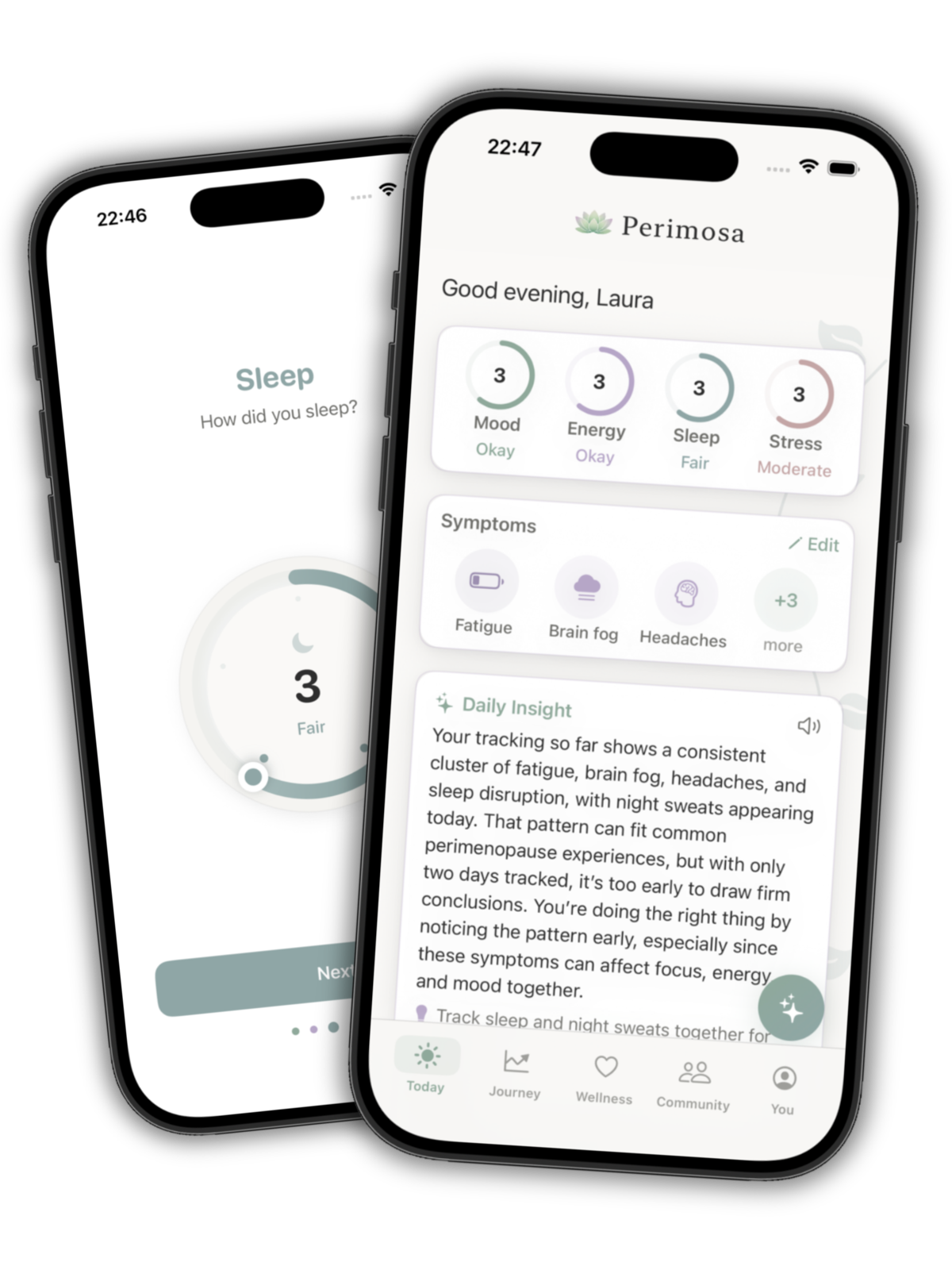
How Pattern Recognition Works in Perimosa
Multi-Variable Correlation
The AI analyzes relationships between all your tracked variables simultaneously: sleep, mood, energy, stress, hot flashes, brain fog, and every logged symptom.
Temporal Pattern Detection
Patterns do not always show up same-day. Perimosa's AI looks across time windows, detecting delayed effects like how Tuesday's poor sleep affects Thursday's brain fog.
Trigger Identification
Discover which lifestyle factors, environmental conditions, or symptom combinations tend to precede your worst days. Turn vague suspicions into data-backed understanding.
Trend Analysis
See whether individual symptoms or overall wellbeing are improving, stable, or declining over weeks and months. Measure the real impact of changes you have made.
Why Pattern Recognition Matters for Menopause Symptoms
The human brain is excellent at noticing immediate cause-and-effect relationships. You eat something spicy and get a hot flash an hour later. But perimenopause patterns are often more subtle and delayed. A sequence of three nights with slightly reduced sleep quality might trigger a brain fog episode two days later. Elevated stress over a week might increase hot flash frequency the following week. Your mood might follow a pattern that is loosely tied to your cycle but offset by several days. These are real patterns that show up clearly in data analysis but are virtually invisible to day-to-day observation. AI pattern recognition bridges this gap, turning your daily experiences into legible, actionable knowledge.
What Kinds of Patterns Does Perimosa Detect?
Perimosa's pattern recognition engine looks for several categories of insight. Correlation patterns show which symptoms tend to appear together or follow each other. Trigger patterns identify factors that precede symptom flare-ups, such as caffeine intake before hot flashes or consecutive poor sleep nights before brain fog. Cycle-related patterns reveal how symptoms shift relative to your menstrual cycle timing, even as that cycle becomes irregular. Trend patterns show how individual symptoms and overall wellbeing are changing over longer periods. And compound patterns identify situations where multiple factors combine to produce effects, like stress plus poor sleep plus caffeine creating a particularly bad symptom day.
From Pattern to Action
Understanding patterns is only valuable if it leads to useful action. Perimosa presents each pattern insight with context about what the data shows and why it matters. When the AI identifies that your hot flashes increase after evenings with alcohol, you have a concrete, testable change you can make. When it shows that your mood consistently improves on days you log moderate exercise, that reinforces a helpful habit. When it reveals that your brain fog is strongly correlated with sleep quality from two nights prior, you know exactly where to focus your energy. Patterns also give you powerful material for conversations with healthcare providers, transforming subjective experiences into objective observations.
What women are saying
“The AI insights are like having a really smart friend who remembers everything. It noticed my migraines always come 3 days before my period shifts. No doctor had ever connected those dots for me.”
Diana, 49
Tracking for 4 months
Frequently Asked Questions
How much data does pattern recognition need?+
Initial simple patterns, like same-day correlations between sleep and mood, can appear after about 2 weeks of daily tracking. More complex patterns, like delayed effects or multi-variable interactions, typically emerge after 4-6 weeks. The AI continues to find deeper patterns as your dataset grows over months.
How accurate is the pattern recognition?+
Perimosa identifies statistical patterns in your data and presents them as observations, not certainties. The AI shows you what the data suggests and how strong the correlation is. As with all pattern detection, some observed correlations may be coincidental, which is why Perimosa encourages you to test insights by making changes and tracking results.
Can the AI detect patterns my doctor would miss?+
Doctors typically have minutes per appointment and rely on your verbal description. Perimosa's AI has access to your complete daily tracking history and can analyze hundreds of data points simultaneously. It often surfaces connections that would be very difficult to identify during a brief medical visit. However, the AI provides observations, not diagnoses, and your doctor's clinical expertise is irreplaceable.
Is my data used to train the AI?+
No. Your personal health data is never used to train AI models. Your data is encrypted, stored securely, and analyzed only to generate your personal insights. We do not share your data with third parties.
What if the AI does not find any patterns?+
If no clear patterns are found after sufficient tracking time, that itself is useful information. It may mean your symptoms are driven by factors not captured in tracking, or that the variation is genuinely random. The AI will continue monitoring as you add more data and will alert you when new patterns emerge.
Let AI reveal the patterns in your perimenopause
Start tracking daily and get personalized pattern insights within weeks. Perimosa is free to download.
Free on iOS · Android
AI insights are observational and based on your tracked data. They are not medical diagnoses. Consult your healthcare provider for medical decisions.