Track perimenopause brain fog and discover what clears it.
A perimenopause brain fog tracker helps you log episodes of mental cloudiness, memory lapses, and concentration difficulties so you can identify triggers and patterns in your cognitive symptoms. Perimosa tracks brain fog alongside sleep, stress, and other factors to show you the full picture.
Brain fog during perimenopause is real, common, and deeply frustrating. You forget words mid-sentence. You walk into rooms and cannot remember why. You reread the same paragraph four times. Up to 60% of perimenopausal women report cognitive difficulties, yet brain fog remains one of the most dismissed and misunderstood symptoms. Perimosa helps you track and understand it, so you can stop blaming yourself and start seeing the patterns.
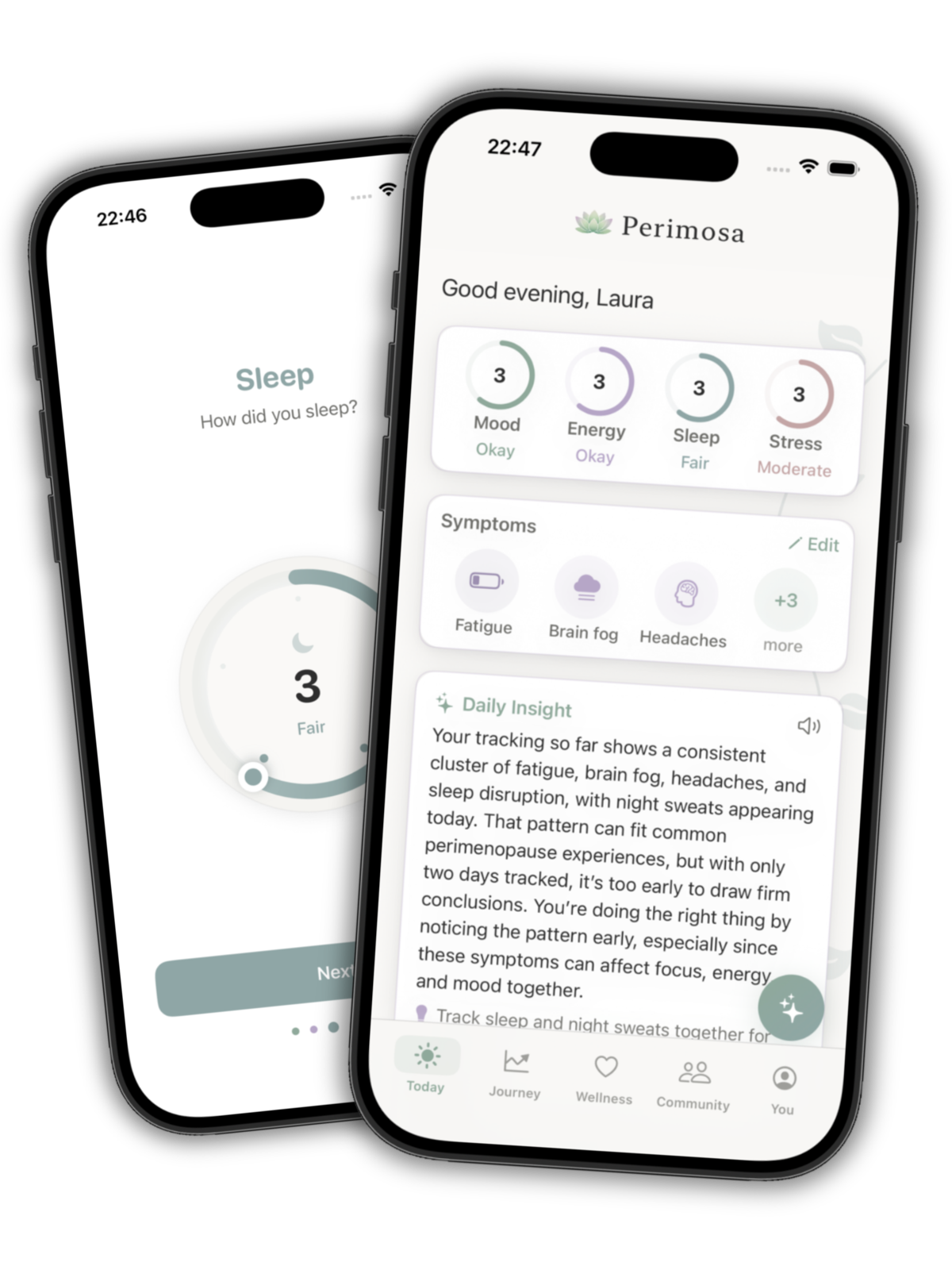
How Perimosa Tracks Brain Fog
Daily Cognitive Check-in
Rate your mental clarity, focus, and memory each day as part of your quick check-in. Track severity from mild haziness to full-blown fog.
Sleep-Fog Connection
See how your sleep quality directly impacts next-day brain fog. Perimosa's AI identifies the sleep thresholds that predict your clearest and foggiest days.
Trigger Identification
Discover whether stress, poor sleep, hormonal shifts, diet, or specific activities precede your worst brain fog episodes.
Clarity Trend Tracking
See whether your cognitive symptoms are improving, stable, or worsening over weeks and months. Measure the impact of lifestyle changes on your mental clarity.
Why Does Perimenopause Cause Brain Fog?
Estrogen plays a significant role in brain function, affecting memory, attention, and verbal fluency. During perimenopause, estrogen levels fluctuate unpredictably, and these fluctuations directly impact cognitive processing. Research shows that the brain adapts to new hormone levels over time, which is why brain fog often improves as women move through the transition. But during perimenopause itself, the constant ups and downs of estrogen can make your brain feel like it is running on an unreliable power supply. Sleep disruption from night sweats compounds the problem, as does the stress and anxiety that often accompany this life stage.
What Brain Fog Patterns Can Tracking Reveal?
Consistent tracking often reveals surprising connections. Many Perimosa users discover that their brain fog is heavily influenced by sleep quality, not just duration but quality. Others find that their cognitive symptoms cluster around specific points in their cycle. Some notice that high-stress days do not cause immediate brain fog but trigger it 24-48 hours later. Caffeine, hydration, exercise, and even screen time can all show up as factors. The key is that these patterns are unique to each person. What causes brain fog for one woman may have no effect on another. That is why personal tracking is more valuable than general advice.
Brain Fog Is Not a Character Flaw
One of the hardest parts of perimenopause brain fog is the self-doubt it creates. You might wonder if you are developing dementia. You might feel embarrassed at work when you cannot find the right word. You might think you are simply not trying hard enough. Tracking your brain fog with Perimosa serves an important psychological function: it externalizes the experience. When you can see in your data that brain fog follows a predictable pattern tied to sleep disruption or hormonal cycles, it stops being a personal failing and becomes a physiological response that you can work with. That shift in perspective matters as much as any specific intervention.
What women are saying
“I thought I was losing my mind. Brain fog, anxiety, mood swings out of nowhere. Perimosa helped me see it was all connected to my cycle changes. The AI showed me that my worst fog days always follow two nights of disrupted sleep.”
Rachel, 41
Tracking for 2 months
Frequently Asked Questions
Is brain fog a real symptom of perimenopause?+
Yes. Cognitive changes during perimenopause are well-documented in medical literature. Up to 60% of perimenopausal women report difficulties with memory, concentration, and word-finding. Fluctuating estrogen levels directly affect brain function, particularly in areas related to verbal memory and attention.
How do I track brain fog in Perimosa?+
Brain fog is tracked as part of your daily check-in. You rate your mental clarity and focus, and you can log specific cognitive symptoms like memory lapses, difficulty concentrating, word-finding problems, and mental cloudiness with severity levels.
Will my brain fog go away after menopause?+
Research suggests that cognitive difficulties often improve once hormone levels stabilize after the menopausal transition. Many women report clearer thinking post-menopause. However, experiences vary. Tracking your patterns can help you identify factors that improve your clarity right now.
Can Perimosa help me improve my brain fog?+
Perimosa helps you identify what triggers your brain fog and what correlates with your clearest days. By understanding your personal patterns, such as the connection between sleep quality and next-day cognition, you can make targeted adjustments. The app does not provide medical treatment recommendations.
Should I see a doctor about perimenopause brain fog?+
If cognitive changes are affecting your daily life or causing significant distress, consulting a healthcare provider is recommended. Bringing your Perimosa tracking data to the appointment can help your doctor understand the pattern and severity of your symptoms.
Start tracking your brain fog today
Understand what triggers it, what clears it, and how it connects to the rest of your experience. Perimosa is free to download.
Free on iOS · Android
Perimosa is a tracking and awareness tool. If you are experiencing significant cognitive changes, please consult a healthcare provider to rule out other conditions.