"How long does this last?" is one of the most common questions women ask about perimenopause. The honest answer is more useful than the simple one: perimenopause averages 4-8 years, but individual experience varies dramatically. Some women transition in under 2 years; others spend more than a decade in it. This guide covers what determines duration, the four formal stages, signs you're nearing the end, and how to navigate the timeline well.
This article is for informational purposes only and is not medical advice. Always consult a healthcare provider about your specific situation.
The average and the range
According to the Study of Women's Health Across the Nation (SWAN), the largest and longest-running study of the menopausal transition, perimenopause has a median duration of about 4 years from the first noticeable cycle changes to the final menstrual period. The interquartile range (middle 50% of women) is 2 to 8 years. About 10% of women have a very short transition (under 2 years), while another 10% spend over a decade in it.
The Menopause Society generally describes perimenopause as lasting 4-8 years. ACOG's patient education materials use similar ranges. The wide spread reflects real biological variation rather than measurement error.
The four stages of perimenopause (and how long each lasts)
Researchers use a formal staging system called STRAW (Stages of Reproductive Aging Workshop) to describe where a woman is in her transition. Knowing the typical duration of each stage helps you anticipate what's coming.
Stage 1: Early Menopausal Transition (4-7 years on average)
This stage begins when your cycles start varying by 7+ days from your previous pattern. Symptoms are typically mild but persistent: cycle variability, intensifying PMS, mild sleep changes, occasional hot flashes, mood shifts. Most women remain in this stage for several years before progressing — making it the longest single phase.
This is the phase most often missed by doctors because cycles still occur regularly enough that perimenopause "doesn't fit."
Stage 2: Late Menopausal Transition (1-3 years on average)
Defined by at least one gap of 60+ days between periods. Hot flashes and night sweats typically peak here. Sleep is most disrupted. Mood swings intensify. Vaginal dryness becomes noticeable. This is usually the hardest phase symptomatically — but it's also the shortest.
Menopause: A single retrospective day
Menopause is technically defined as the 12-month mark after your final menstrual period. It's a single calendar day, identifiable only in hindsight. Before it, you're in late menopausal transition; after it, you're postmenopausal.
Stage 3: Early Postmenopause (5-8 years)
Hot flashes typically continue but gradually decrease in frequency. Bone density loss is fastest in the first 2-3 years. Vaginal and urinary symptoms often persist or worsen. Mood typically stabilizes as hormone swings stop.
Stage 4: Late Postmenopause (rest of life)
Begins approximately 5-8 years after your final period. Most vasomotor symptoms have diminished significantly. Long-term focus shifts to bone, cardiovascular, and cognitive health.
What affects duration
Age of onset
This is the strongest predictor. Women whose perimenopause begins earlier (late 30s or early 40s) tend to have longer transitions — often 8-15 years. Women whose perimenopause begins later (late 40s) tend to have shorter transitions — often 2-5 years. The total reproductive lifespan has some self-balancing built in, though the variation is still wide.
Genetics
Your mother's perimenopause length and age at menopause are strong predictors of your own. If your mother had a long, difficult perimenopause that started in her late 30s, that's predictive (though not deterministic) for you.
Smoking
Smoking accelerates ovarian function decline and typically advances menopause by 1-2 years. It also tends to extend the perimenopausal phase because the decline pattern becomes more chaotic. Quitting smoking before or during perimenopause can affect both timing and severity.
BMI extremes
Very low or very high BMI is associated with different patterns. Higher BMI is associated with later menopause (because adipose tissue produces some estrogen) but often more severe vasomotor symptoms. Very low BMI is associated with earlier menopause.
Ethnicity
SWAN data shows meaningful variation. African American and Hispanic women tend to experience longer durations of vasomotor symptoms (median 10+ years for African American women). Asian women tend to experience shorter durations. White women fall in between. These differences appear to reflect biological variation, not measurement bias.
Reproductive history
Number of pregnancies, whether you breastfed, age at menarche, and use of hormonal contraception all have small effects on perimenopause timing. Never having been pregnant is associated with slightly earlier perimenopause.
Medical history
Certain conditions and treatments accelerate the transition: chemotherapy, radiation to the pelvis, ovarian surgery, autoimmune conditions affecting the ovaries (especially autoimmune thyroid disease), and certain genetic conditions like Fragile X premutation.
Chronic stress
Severe chronic stress and HPA-axis dysfunction can affect ovarian function timing, though the magnitude is debated. Other lifestyle factors (sleep quality, exercise, nutrition) have smaller individual effects but cumulatively matter.
Signs perimenopause is ending
Several markers suggest you're in late perimenopause and likely within 1-3 years of menopause:
- Cycles consistently 60+ days apart
- Periods becoming lighter when they do occur
- Hot flashes at peak frequency and severity
- Vaginal dryness becoming noticeable
- Sleep at its worst
- FSH consistently elevated above 25-30 mIU/mL
- AMH undetectable
None of these alone confirms you're ending perimenopause — only the 12-month marker after your final period is definitive. But the cluster suggests you're getting close.
What about pregnancy during this time?
You can still get pregnant during perimenopause until you've gone 12 consecutive months without a period. Cycles in late perimenopause are often anovulatory but not always. Women have become pregnant after 9-10 months of amenorrhea, then had a baby. If pregnancy isn't desired, continue contraception until you've definitively reached menopause. Discuss appropriate contraception options with your doctor — some women shift from combined hormonal contraception to progestin-only or non-hormonal methods.
How tracking helps you navigate the timeline
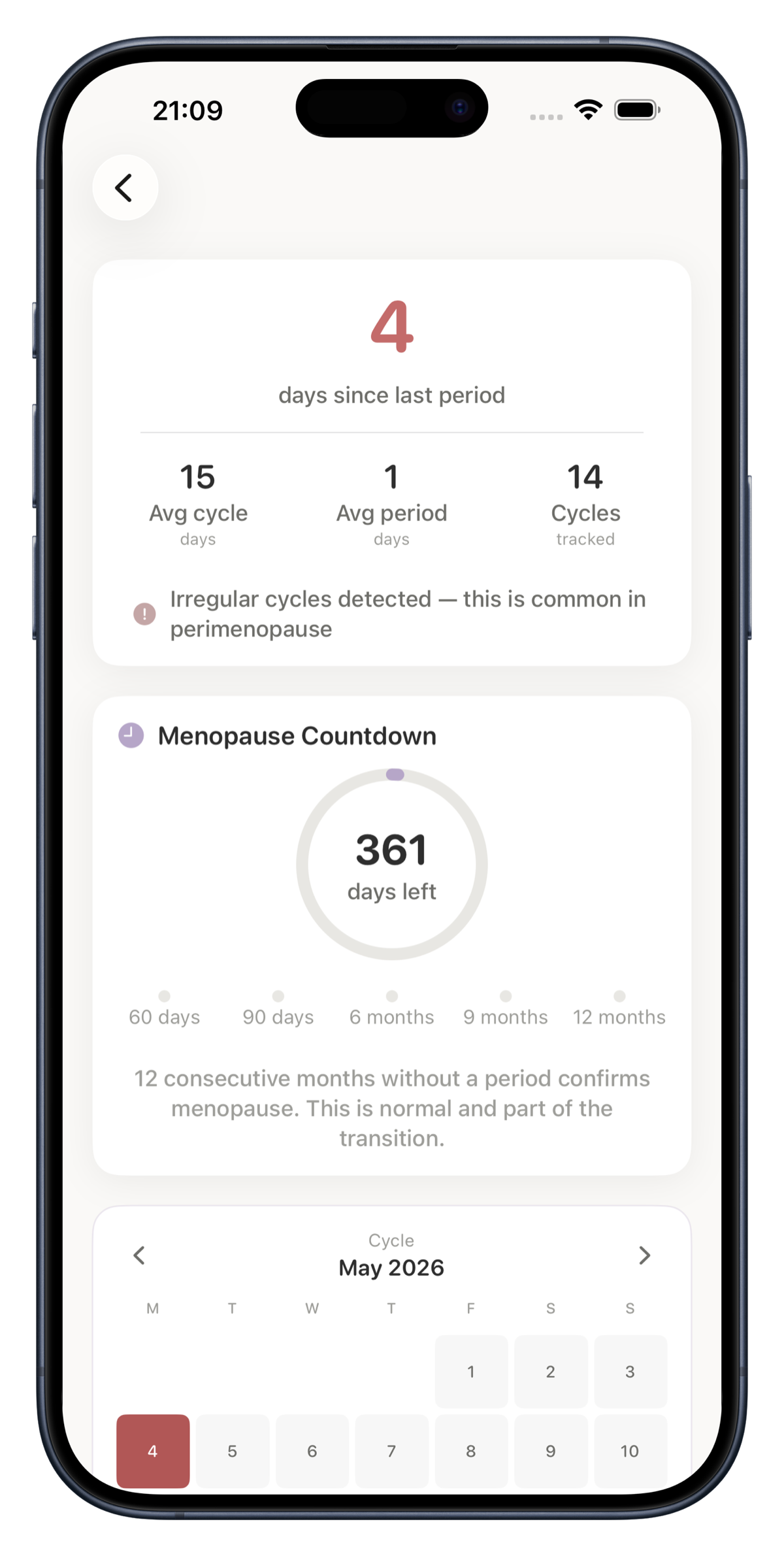
Without consistent cycle tracking, the perimenopausal timeline blurs together. You can't tell where you are or how far you've come. With tracking in Perimosa, you build a longitudinal record that:
- Identifies your current stage based on cycle pattern
- Shows symptom trajectory over months (worsening, peaking, or improving)
- Captures the precise date of your final period when it happens (most women genuinely can't remember without tracking)
- Documents the 12-month timeline definitively rather than approximately
- Provides the longitudinal data your doctor needs for treatment decisions
This matters more than most women realize until they try to recall details years later. Women who haven't tracked often confuse the start of perimenopause, the peak, the final period, and the postmenopausal phase — making informed treatment decisions harder.
What you can and can't control
The biological timeline of perimenopause is mostly determined by factors outside your control: genetics, age of onset, ovarian reserve. Treatment doesn't shorten it — it manages symptoms within whatever timeline your body is on.
What you CAN control:
- How severely symptoms impact your daily life (through treatment and lifestyle)
- Your overall health during the transition (sleep, exercise, nutrition, stress management)
- How prepared you are for each stage (knowing what's coming)
- Whether you have informed care from a menopause-trained doctor
- Whether you have the data to make good treatment decisions
Accepting that the timeline is what it is — and focusing energy on the controllable factors — produces a better experience than fighting biology head-on.
The Bottom Line
Perimenopause lasts an average of 4-8 years, with significant individual variation from under 2 years to over a decade. The four stages each have typical durations: early menopausal transition (4-7 years), late menopausal transition (1-3 years), early postmenopause (5-8 years), late postmenopause (the rest of life). Age of onset, genetics, smoking, BMI, ethnicity, and medical history all affect duration. The transition formally ends 12 months after your final period — a date identifiable only in hindsight, which is why consistent tracking matters.
What you can't change: the underlying biological timeline. What you can change: how you experience it. Build foundation health habits, find a menopause-trained doctor, track your patterns, and make informed treatment decisions at each stage.