Every week, thousands of women search "is this perimenopause" — usually after months of unexplained symptoms, dismissive doctor visits, and the slow realization that something has fundamentally changed. The diagnosis is harder than it should be because there's no single definitive test. But the pattern is usually recognizable when you know what to look for. This guide walks you through how to know — with reasonable confidence — whether you're in perimenopause.
This article is for informational purposes only and is not medical advice. Always consult a healthcare provider about your specific symptoms.
The diagnostic challenge
Perimenopause is a clinical diagnosis based on pattern recognition, not a single test. Hormone levels fluctuate so much during the transition that a single blood draw can show "normal" levels even when you're clearly perimenopausal. This is why doctors who rely solely on FSH tests often miss it. The diagnosis comes from combining:
- Age within the typical range (most commonly 40-50, but 35-55 is the broader window)
- Menstrual cycle changes
- Constellation of classic symptoms
- Symptom progression over time
- Exclusion of other causes
The age question
Perimenopause typically begins in your early to mid-40s, with the average woman reaching menopause around age 51. But the range is wider than most realize:
- Most common: 40-50
- Normal range: 35-55
- Earlier onset (5-10% of women): Late 30s, occasionally earlier with genetic factors, autoimmune conditions, smoking, or prior chemotherapy/radiation
- Premature ovarian insufficiency: Before 40 — requires medical evaluation
"You're too young" is not a clinical conclusion. It's an assumption that needs evidence. If you're 38 with classic symptoms, perimenopause is on the table.
The cycle changes
Menstrual cycle changes are the most reliable indicator. Look for:
- Cycle length variability. Your cycles varying by 7+ days from your previous pattern. Not a single off month — a consistent pattern of variability.
- Shorter cycles. Cycles becoming consistently shorter (every 22-25 days instead of 28-30) is common early in perimenopause.
- Heavier or lighter flow. Changes in flow volume that persist for several cycles.
- Spotting between periods. Mid-cycle spotting becomes more common.
- Skipped periods. In later perimenopause, gaps of 60+ days between periods.
- Cycle length unpredictability. Even if average length is similar, the variability month-to-month is much greater.
Note: if you're on hormonal contraception or have had a hysterectomy, you may not be able to use cycle changes as a marker — making the symptom pattern even more important.
The symptom constellation
Perimenopause typically produces multiple symptoms together, not isolated single complaints. The presence of 3 or more of the following — appearing or worsening within the same 6-12 month period — is highly suggestive:
Vasomotor symptoms:
- Hot flashes (sudden wave of heat, often in chest/face)
- Night sweats (often drenching enough to require changing sleepwear or sheets)
- Cold flashes (less discussed but common)
Sleep changes:
- Difficulty falling asleep
- 3am wake-ups with inability to fall back asleep
- Sleep that feels less restorative even when adequate in duration
Mood and cognitive:
- New or worsening anxiety
- Mood swings or rage episodes
- Depression or low mood
- Brain fog or word-finding difficulty
- Memory lapses
Physical:
- Joint pain or stiffness, especially morning
- Weight changes, especially around the midsection
- Headaches or migraines
- Heart palpitations
- Vaginal dryness
- Skin and hair changes
The progression pattern
Perimenopause symptoms progress over months. A symptom that emerges once and disappears is probably not perimenopause. Symptoms that emerge gradually, persist for months, and slowly intensify or proliferate are typical.
The trajectory typically looks like:
- Year 1-2: Subtle cycle changes, intensifying PMS, mild sleep changes
- Year 3-5: More noticeable vasomotor symptoms emerge, mood instability increases, brain fog more frequent
- Year 5-7: Peak symptoms — hot flashes, sleep fragmentation, mood swings often at their worst, cycle becomes increasingly irregular
- Year 7-10: Late perimenopause — skipped periods, eventual final period
Individual variation is significant. Some women have a shorter, easier transition; others longer and more difficult.
What it's probably NOT (alternative diagnoses to rule out)
Several conditions mimic perimenopause and deserve consideration:
- Thyroid dysfunction. Hypothyroidism causes fatigue, brain fog, weight gain, depression, hair loss. Hyperthyroidism causes anxiety, heart palpitations, sleep disruption, sweating. Get a full thyroid panel (TSH, free T3, free T4, TPO antibodies).
- Iron deficiency. Common with heavy perimenopausal bleeding. Causes fatigue, brain fog, hair loss, restless legs. Check ferritin specifically (not just hemoglobin).
- Vitamin D deficiency. Mimics fatigue, mood issues, joint pain.
- B12 deficiency. Causes fatigue, brain fog, mood changes, tingling in extremities.
- Sleep apnea. Underdiagnosed in women. Causes fatigue, brain fog, mood symptoms.
- Anxiety or depression as primary disorders. Can produce many overlapping symptoms.
- Autoimmune conditions. Lupus, rheumatoid arthritis, others can emerge in this age range.
- Pregnancy. Still possible until 12 months without a period — test if there's any chance.
Most of these can co-exist with perimenopause. Ruling them out (or treating them alongside perimenopause if present) is part of thorough evaluation.
How to confirm with reasonable certainty
The most reliable path to confirming whether you're in perimenopause:
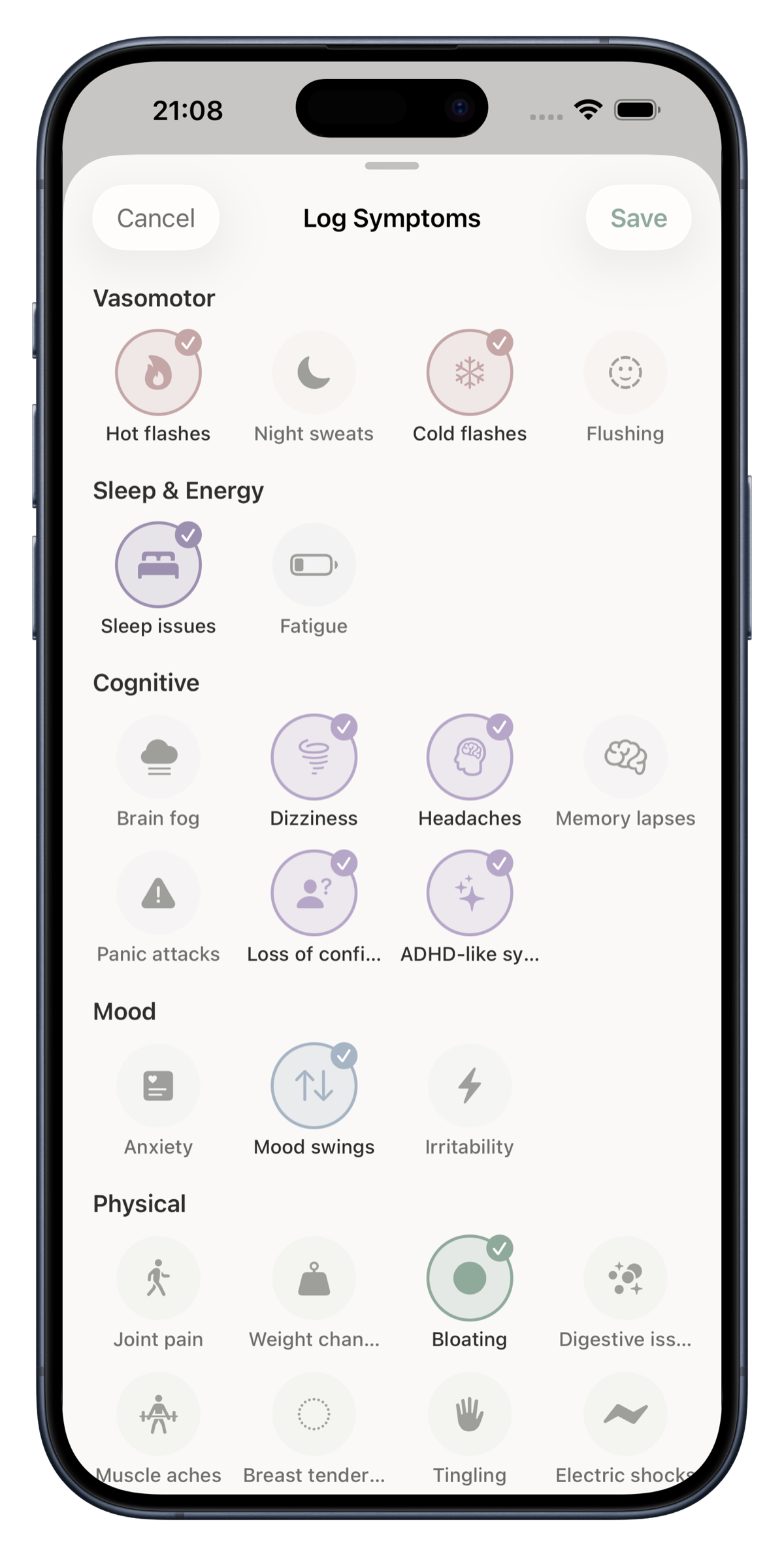
- Track for 2-3 months. Log cycle, symptoms (severity 0-10), sleep, mood, and any new physical changes daily. Apps like Perimosa are designed for this.
- Review the pattern. Are you seeing cycle variability? Multiple symptoms together? Progression over weeks?
- Schedule a doctor appointment specifically for this. Don't try to fit it into a regular wellness visit.
- Request comprehensive blood work. FSH (day 2-3, repeated 6-8 weeks later), AMH, estradiol, full thyroid panel, prolactin, fasting glucose/A1c, ferritin, vitamin D, B12.
- Bring your tracked data. The pattern visible across 2-3 months is more compelling than any single appointment description.
- Be open to the conclusion. The data might confirm perimenopause. It might reveal a thyroid issue, deficiency, or other condition. Or both. The goal is accuracy, not confirmation bias.
What to do if you're sure but your doctor isn't
If your tracked data clearly shows perimenopause patterns and your doctor still dismisses, you have options:
- Ask specifically: "What additional evaluation would help confirm or rule out perimenopause?"
- Request a referral to a gynecologist or menopause-trained specialist
- Use The Menopause Society directory to find a certified menopause practitioner
- Consider telehealth menopause services if local options are limited
The Bottom Line
If you're 35-55, your cycles have changed, you have 3+ classic symptoms emerging together, and the pattern has persisted for 3+ months — you're very likely in perimenopause. No single test confirms it definitively, but the pattern over time usually makes it clear. Track for 2-3 months, get appropriate blood work, rule out alternatives, and don't accept dismissal based on age alone.
You're not crazy. You're not just stressed. Your body is going through a real biological transition that affects nearly every system. Recognizing it is the first step toward managing it well over the next decade.