Perimenopause fatigue is real, common, and qualitatively different from ordinary tiredness. About 40-50% of perimenopausal women report fatigue severe enough to interfere with work, relationships, and daily function. It is also one of the most misdiagnosed symptoms — frequently attributed to depression, overwork, or "just being busy" when the actual driver is hormonal. This guide covers why it happens, why sleep alone often doesn't fix it, and what actually works.
This article is for informational purposes only and is not medical advice. Persistent or severe fatigue should be evaluated by a healthcare provider to rule out treatable causes like thyroid disease, anemia, or sleep apnea.
What Perimenopause Fatigue Actually Feels Like
Women describe perimenopause fatigue in specific ways that differ from ordinary tiredness:
- Waking unrefreshed even after 7-8 hours in bed
- A "wading through water" sensation through the afternoon
- Energy that crashes after meals (especially carbs)
- Mental fatigue that arrives before physical fatigue
- Improvement after eating but not after rest
- Disproportionate exhaustion after small efforts (a flight of stairs, a single meeting)
- Worse fatigue in the week before periods (when still cycling)
If this pattern matches yours, you are not lazy, depressed, or imagining it. The mechanism is hormonal, and there are evidence-based interventions.
Six Mechanisms Behind Perimenopause Fatigue
1. Fragmented Sleep (Often Undetected)
The biggest single driver. Night sweats fragment sleep architecture even when you don't fully wake — you lose deep sleep and REM cycles without registering the disruption. Hot-flash-related cortisol spikes around 3 a.m. wake many women into a "wired but tired" state that resists going back to sleep. Even women who think they sleep fine often have markedly fragmented architecture under sleep-study conditions.
2. Declining Progesterone
Progesterone is more than a reproductive hormone — it has direct GABA-enhancing effects in the brain and supports recovery and restoration. It typically declines earlier and more steadily than estrogen during perimenopause. Lower progesterone means less efficient deep sleep, more daytime activation, and reduced sense of recovery from rest.
3. Cortisol Dysregulation
Normal cortisol rhythm: low at bedtime, gradually rising overnight, peaking 30-60 minutes after waking, then declining through the day. Perimenopause disrupts this in two common patterns:
- Reversed pattern: elevated cortisol at bedtime (causing trouble falling asleep) + flat low cortisol in the morning (causing tired-on-waking)
- Mid-day crash: sharp drop around 2-4 PM producing intense afternoon fatigue
Both patterns are measurable on a 4-point salivary cortisol test, useful when fatigue is severe.
4. Mitochondrial Function Changes
Estrogen supports mitochondrial efficiency. Lower estrogen reduces ATP production in muscle cells. This is part of why exercise feels harder during perimenopause — your cells are producing less energy from the same metabolic inputs. Supporting mitochondria (with CoQ10, exercise, adequate protein, sleep) becomes more important.
5. Thyroid-Axis Shifts
Estrogen affects thyroid hormone binding. As estrogen fluctuates, thyroid function can become functionally subclinical even with "normal" TSH. Autoimmune thyroid disease also peaks in women during the perimenopausal years. If your fatigue is severe or out of proportion to other symptoms, ask for a full thyroid panel (TSH, free T4, free T3, TPO antibodies) — not just TSH.
6. Iron and B12 Depletion (Often Missed)
Two specific perimenopause patterns deplete these:
- Heavy bleeding from anovulatory cycles depletes iron. Ferritin can be low even with "normal" hemoglobin — and low ferritin alone causes fatigue.
- Stomach acid declines with age, reducing B12 absorption. Mild B12 deficiency causes severe fatigue without any other classic symptoms.
Always check ferritin (not just hemoglobin) and B12 if you have unexplained fatigue.
How Perimenopause Fatigue Differs From Other Fatigue
| Feature | Perimenopause fatigue | Depression-related | Thyroid |
|---|---|---|---|
| Pattern | Cyclic, worst pre-period | Constant, often worse mornings | Constant, doesn't fluctuate |
| After meals | Often improves briefly | Usually no change | No change |
| After rest | Minimal improvement | Minimal improvement | Minimal improvement |
| Sleep | Disrupted, fragmented | Early waking common | Often hypersomnia (too much) |
| Mood | Can be low, but fluctuates | Persistent low mood, anhedonia | Slowed thinking, low mood |
What Actually Helps
1. Fix Sleep Architecture (Not Just Duration)
Address night sweats specifically — they're often the silent fatigue driver. Strategies in our perimenopause insomnia guide apply. Two highest-impact: cool bedroom (65-68°F) and bedtime micronized progesterone if you're on HRT.
2. Stabilize Blood Sugar
Insulin resistance increases during perimenopause. Blood sugar swings cause fatigue waves. Practical moves:
- Protein with every meal (20-30g) — slows glucose rise
- Eat within 1-2 hours of waking — long fasts in the morning worsen cortisol crashes
- Limit refined carbs and sugar; pair starchy foods with fat and protein
- Limit alcohol — it crashes blood sugar overnight, fragmenting sleep
3. Strength Training (Not Just Cardio)
Counterintuitive but well-supported: women who do 2-3 strength sessions per week report less fatigue than those doing only cardio. Strength training preserves muscle mass (which declines steeply in perimenopause), improves insulin sensitivity, and supports mitochondrial function. Aim for compound movements — squats, deadlifts, push-ups, rows.
4. Test Iron, B12, Vitamin D, Thyroid
Before assuming fatigue is "just hormones," rule out the four most common deficiencies. Optimal ranges for energy (not just normal labs):
- Ferritin: at least 50 ng/mL (many women feel best at 70+)
- Vitamin B12: at least 500 pg/mL
- Vitamin D: at least 40 ng/mL
- TSH: 1.0-2.5 mIU/L (with normal antibodies and free T3/T4)
Treating deficiencies often produces dramatic fatigue improvement within 4-12 weeks. Many women have been told "your labs are normal" when their values are in the low-normal range that correlates with symptoms.
5. Caffeine, Reconsidered
Most women in perimenopause are using caffeine to compensate for fatigue — but it often makes the underlying problem worse. Caffeine has a half-life of 5-7 hours, so a 2 PM coffee is still ~50% active at 7 PM, disrupting sleep that night, producing more fatigue tomorrow, requiring more caffeine. The cycle compounds. Worth a 2-week experiment: cap caffeine at one cup before 11 AM and see what changes.
6. Hormone Therapy
If sleep disruption, mood, and hot flashes are central, HRT often produces meaningful fatigue improvement by addressing the upstream causes. Bedtime micronized progesterone alone can dramatically improve sleep and reduce next-day fatigue for many women. See our HRT guide.
When Fatigue Needs Medical Attention
Perimenopause causes fatigue, but it doesn't cause every fatigue. See a doctor promptly if:
- Fatigue is severe enough that you cannot work or perform daily activities
- It is accompanied by unexplained weight loss
- You have night sweats AND fevers, swollen lymph nodes, or other systemic symptoms
- Sleep apnea is possible — snoring, gasping during sleep, neck circumference >16 inches
- Fatigue developed suddenly rather than gradually
- You have a family history of autoimmune disease, especially thyroid
Common medical causes that mimic perimenopause fatigue include: hypothyroidism, iron deficiency anemia, B12 deficiency, sleep apnea, depression, chronic infections (Lyme, EBV reactivation), autoimmune conditions, and rarely, occult malignancy.
Tracking Helps You and Your Doctor
Fatigue is hard to communicate to clinicians — "I'm tired" is universal and dismissable. What changes the conversation is data. Track:
- Energy levels across the day (morning, mid-day, evening)
- Sleep quality vs. fatigue the next day
- Energy correlation with cycle phase
- How quickly meals affect energy
- Specific situations that trigger crashes
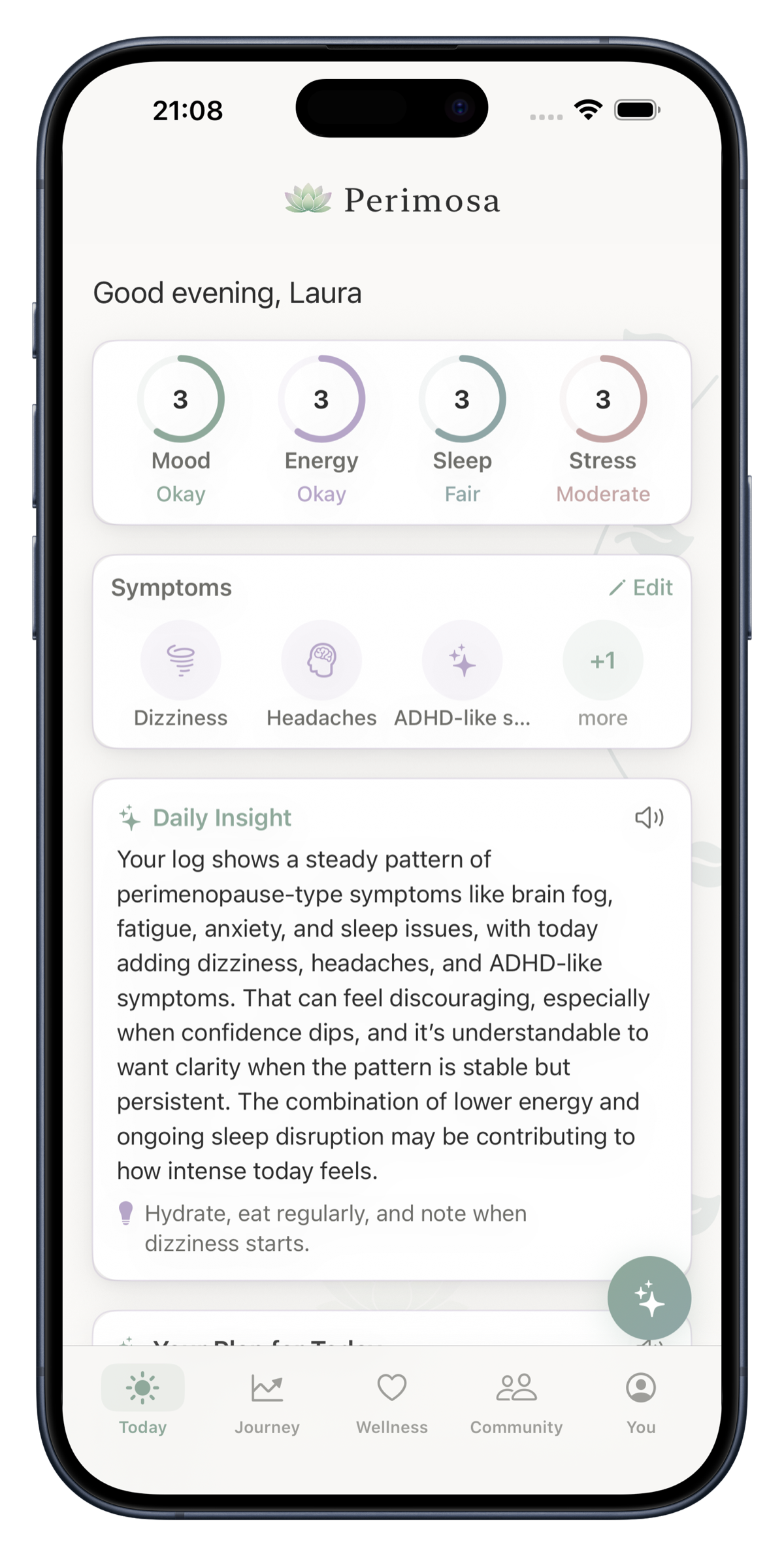
A 30-day log makes the difference between a 5-minute "must be perimenopause" dismissal and a meaningful workup. Perimosa tracks energy alongside sleep, mood, symptoms, and lifestyle so the patterns become visible to you and your doctor.
The Bottom Line
Perimenopause fatigue is a real, multi-system phenomenon — not just feeling tired. Fragmented sleep, declining progesterone, cortisol shifts, mitochondrial changes, possible thyroid involvement, and iron/B12 depletion all contribute. Sleep alone often doesn't fix it because sleep alone isn't the only problem. The most effective approach is multi-pronged: protect sleep architecture, stabilize blood sugar, build muscle, fix deficiencies, reconsider caffeine, and address the hormones directly when severity warrants. Most women feel meaningful improvement within 2-3 months when the right inputs are in place.