Does Perimenopause Change Your Body Shape?
Yes, perimenopause changes your body shape. Declining estrogen shifts fat storage from hips and thighs to the abdomen, muscle mass declines without intervention, and skin loses some elasticity. Many women find their bodies feel unfamiliar -- the same scale weight, but a different silhouette. Strength training and protein help most.
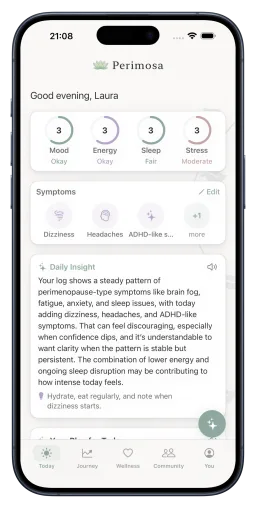
Finally understand what your body is doing
Perimosa logs how you feel each day, finds the pattern, and gives you the words to take to your doctor. Free on iPhone and iPad.
Get the free appThe Estrogen-Driven Shift
Estrogen influences where the body stores fat. Pre-menopausal women under estrogen's influence tend to store fat in the hips, buttocks, and thighs -- the so-called 'pear' shape. As estrogen declines during perimenopause, fat storage shifts toward the abdomen and visceral compartment (around organs). Many women describe waking up at 45 in a body that feels foreign -- thicker waist, narrower hips, an unfamiliar reflection. Scale weight may be similar to a year ago, but distribution is different.
Muscle Loss Changes Shape Too
Beyond fat redistribution, the gradual loss of muscle mass that accelerates after 40 changes shape. Less muscle means softer-looking arms, less defined shoulders and thighs, and overall reduced 'shape.' This is why two women at the same scale weight can look completely different -- one with more muscle has a more defined silhouette. Strength training specifically targets this. Within 12-16 weeks of consistent training, most women notice visible changes in shape even without weight loss.
Skin Changes Compound the Visual
Estrogen supports collagen production and skin elasticity. As estrogen declines, skin becomes thinner, less elastic, and more prone to wrinkles and sagging. This affects how the body looks even with similar underlying fat and muscle. The visual change is real -- it's not just self-perception. Skincare with retinoids, adequate hydration, sun protection, and good nutrition can slow but not stop this. Some women pursue treatments like RF microneedling or laser, which can help but don't reverse the underlying hormonal cause.
What's Within Your Control
Several aspects of body change respond to action. Strength training builds and preserves muscle, restoring some shape. Protein at every meal supports muscle synthesis. Reducing alcohol slows belly fat accumulation. Sleep affects body composition more than people realize -- poor sleep drives visceral fat. Walking and general activity matter. What's less controllable: the underlying hormonal redistribution. Accepting some change while focusing intensely on what you can influence produces both better outcomes and better mental health.
What to Measure Beyond the Scale
Tracking body shape changes during perimenopause requires going beyond the scale, which often misses what's actually happening. Useful measurements to track monthly in Perimosa: waist circumference (at navel), hip circumference at the widest point, waist-to-hip ratio, how specific clothes fit (favorite jeans, specific dress), how you feel in your body, and grip strength if you have a dynamometer. Photos taken in the same lighting and clothing monthly reveal changes you can't perceive day to day. Body composition scans (DEXA, InBody) periodically give precise data. Tracking these reveals that body recomposition is happening even when weight stays stable -- usually muscle declining and fat increasing without intervention.
What's Realistic to Change and What Isn't
Setting realistic expectations matters. Things that respond well to consistent effort: muscle definition (strength training), waist circumference (combination of training, nutrition, sleep, alcohol reduction), posture (deliberate work on core, back, mobility), skin tone (skincare, sun protection, hydration), body composition overall. Things that don't fully reverse: fundamental fat distribution patterns (estrogen-driven pear shape becomes more android pattern), skin elasticity (slows but doesn't fully restore), bone structure changes (chest cage widening, height loss without prevention). Focusing energy on what's controllable while accepting what isn't produces better outcomes than fighting biology head-on.
Why Acceptance Plus Action Beats Pure Resistance
Many women approach body changes during perimenopause with pure resistance -- trying to maintain the body they had at 30. This pattern often produces frustration, disordered eating, and worse outcomes than acceptance plus targeted action. The healthier framing: accept that some change is inevitable, focus intensely on what you can influence (muscle, strength, posture, skin care, body composition), and let go of what you can't (some fat redistribution, some skin changes, some structural shifts). Women who maintain this balance through perimenopause often emerge with bodies they're genuinely happy with -- not the same as 30, but strong, capable, and healthy.
Bottom Line
Perimenopause changes body shape through fat redistribution, muscle loss, and skin changes -- all driven by declining estrogen. Track meaningful metrics in Perimosa (waist, hip, grip strength, fit of specific clothes, photos) rather than relying on the scale. Focus action on what's controllable: muscle through strength training, body composition through nutrition and sleep, posture through deliberate work. Accept what isn't fully reversible -- some change is biology, not personal failure. The goal is a strong, healthy body that serves you for decades, not preservation of how you looked at 30. Women who hold this balance navigate the transition better than those who fight it head-on.
References
Medical disclaimer: This article is for informational purposes only and does not constitute medical advice. Always consult a qualified healthcare provider for diagnosis and treatment decisions. Perimosa is a symptom tracking tool, not a medical device.