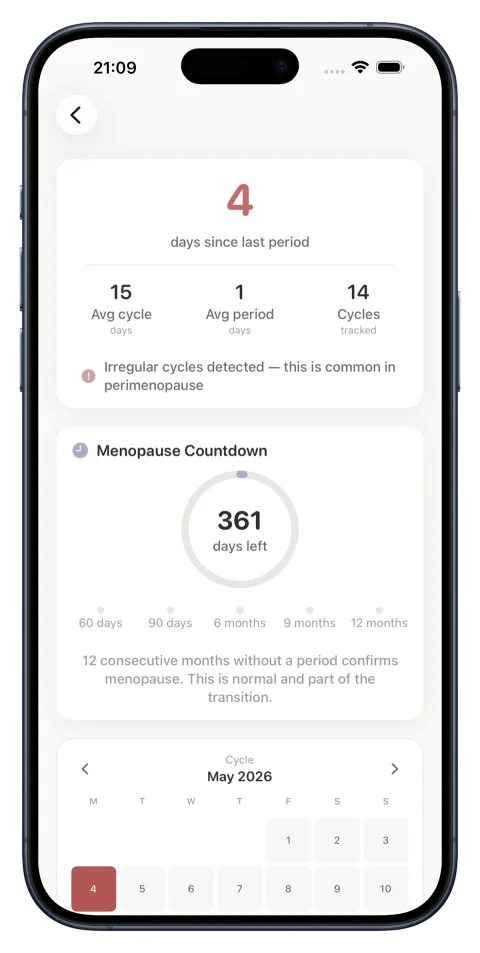
For most women the first real signal of perimenopause is not a hot flash. It is the calendar. Periods start arriving at 24 days instead of 28, then skip a month, then return heavier than they have been in years. Nothing about it feels like a pattern, which is exactly why it is so unsettling.
There is a pattern underneath it, though, and it is reasonably well described. Knowing what the transition normally looks like makes it much easier to tell ordinary upheaval from the handful of bleeding changes that genuinely need looking at.
This article is for informational purposes only and is not medical advice. Bleeding changes have many causes, and only your healthcare provider can evaluate yours.
Why cycles become irregular
A regular cycle depends on a predictable conversation between the ovaries and the brain. As the pool of remaining follicles shrinks, that conversation gets noisy. FSH rises, sometimes recruiting a follicle faster than usual and sometimes failing to recruit one at all. Estrogen stops declining in an orderly way and instead swings, occasionally reaching levels higher than in your thirties before dropping sharply.
Two consequences follow, and they explain most of what women actually experience:
- Cycles shorten first. A faster follicular phase means the whole cycle arrives sooner. This is why early perimenopause often feels like periods are constantly on top of you.
- Ovulation becomes intermittent. A cycle without ovulation produces no progesterone. Estrogen continues to build the uterine lining with nothing to stabilise it, so the lining grows thicker and eventually sheds in an unpredictable, often heavy bleed.
The recognised stages of cycle change
Researchers describe the transition in stages, and the boundaries are defined by exactly the thing you can see on a calendar.
| Stage | What the cycle does | Typically lasts |
|---|---|---|
| Late reproductive | Still regular, but subtly shorter; periods may be heavier | Several years |
| Early transition | A persistent difference of 7+ days in cycle length | Variable, often years |
| Late transition | A gap of 60 days or more between periods | 1–3 years |
| Menopause | 12 consecutive months with no period | Confirmed in hindsight |
The detail worth holding onto is that the early transition is defined by a persistent change, not a single odd month. One 22-day cycle after a stressful fortnight means little. Six months of cycles that used to be 28 days and now range from 22 to 35 is the transition.
What counts as normal irregularity
Broadly, these are expected and not a cause for concern on their own:
- Cycles that shorten by a few days, then start varying widely
- Skipped months, especially later in the transition
- Periods that are heavier than they used to be, within the limits below
- Periods that become much lighter, or last only a day or two
- Worse cramping, or cramping that appears when you never used to get it
- More pronounced PMS, breast tenderness or mood change in the week beforehand
Which bleeding changes need a doctor
These are the patterns clinicians want to know about. They are not rare, and most turn out to be fibroids, polyps or a thickened lining rather than anything sinister. But they are investigated rather than watched.
| Feature | Expected in perimenopause | Worth a workup |
|---|---|---|
| Cycle length | Varies, 21–60+ days | Consistently under 21 days |
| Period length | Up to about 7 days | Beyond 7 days, repeatedly |
| Flow | Heavier than before, manageable | Soaking a pad or tampon hourly for several hours |
| Clots | Small, occasional | Larger than a coin, routinely |
| Between periods | Occasional light spotting | Repeated bleeding between periods, or after sex |
| After menopause | Nothing | Any bleeding at all, always |
That final row is the one to remember without qualification. Once twelve months have passed with no period, bleeding is never treated as part of the transition.
Why your calendar is the most useful thing you own
There is no blood test that diagnoses perimenopause. FSH swings so much from week to week that a single reading says very little, which is why guidelines advise against relying on hormone testing for women over 45. The diagnosis is made from your history — your age and the pattern of your cycles.
Which means the record you bring to the appointment largely determines the quality of the appointment. "My periods have been all over the place" and "over the last eight months my cycles ran 24, 26, 22, 41, 25, 60, 23 and 29 days, and three of those were heavy enough to change protection hourly" lead to very different conversations.
How long does this go on for?
Longer than most women are led to expect. The menopause transition commonly runs four to eight years from the first persistent cycle change to the final period, and the late stage — the one with the long gaps — typically accounts for one to three of those years.
The average age at menopause is around 51, but the spread is wide and perfectly normal between roughly 45 and 55. Before 45 it is called early menopause, and before 40 premature ovarian insufficiency; both are worth proper assessment rather than being treated as the transition arriving ahead of schedule.
Two things make the timeline feel longer than it is. The early stage is easy to miss at the time, so it is often only recognised in hindsight, which stretches the apparent duration. And the final stretch is the most erratic, so the point at which things feel worst is usually the point nearest the end.
The contraception question
Worth stating plainly, because it catches people out: irregular cycles are still potentially fertile cycles. Ovulation in perimenopause becomes unpredictable rather than absent, and it can return after months of apparent quiet.
The standard advice is contraception until twelve consecutive months without a period if you are over 50, and two years if you are under 50 — the longer window reflecting the greater chance that ovulation reappears. Pregnancies in the mid-forties are not rare, and a good proportion are unplanned because the cycle had seemed to be winding down.
Some methods do double duty here. A hormonal IUD both reduces heavy bleeding and provides contraception. Combined hormonal contraception can regulate erratic cycles for women who are able to take it, though suitability depends on blood pressure, migraine history, smoking and other factors your doctor will weigh.
What helps
Irregularity itself does not usually need treating. Its consequences sometimes do.
- For heavy bleeding: a hormonal IUD is often first-line and substantially reduces flow. Tranexamic acid taken during a period is a non-hormonal option. Iron is worth checking, because heavy cycles over months deplete it quietly.
- For unpredictability: combined hormonal contraception can regulate cycles for women who can take it, and doubles as contraception, which is still needed.
- For the wider transition: hormone therapy addresses hot flashes, sleep and mood, though it is not primarily a treatment for irregular bleeding.
- Always: new heavy or intermenstrual bleeding is examined before it is medicated, usually with an ultrasound and sometimes a lining biopsy.
The Bottom Line
Irregular periods are the defining feature of perimenopause, not a complication of it. Cycles usually shorten before they lengthen, skipped months become normal late in the transition, and the whole thing can take several years. What does not belong is bleeding that is very heavy, lasts beyond a week, comes more often than every 21 days, happens between periods, or appears after a full year without one. Because the diagnosis rests on the pattern rather than a blood test, a written record of your cycles is the single most useful thing you can bring to your doctor.