Can You Have Perimenopause Symptoms and Still Have Periods?
Yes, you can have perimenopause symptoms while still having periods -- this is actually the most common pattern. Perimenopause begins years before periods stop, with hot flashes, sleep disruption, mood changes, and other symptoms appearing while menstruation continues. Your periods may even seem completely normal in the early years.
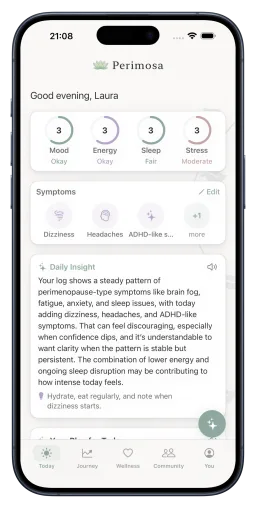
Finally understand what your body is doing
Perimosa logs how you feel each day, finds the pattern, and gives you the words to take to your doctor. Free on iPhone and iPad.
Get the free appSymptoms Come Before Cycles Stop
A widespread misconception is that perimenopause means your periods are nearly done. In reality, perimenopause begins when ovarian function starts declining -- which can be 8-10 years before your final period. During those years, your cycles may be perfectly regular while you experience hot flashes, night sweats, anxiety, sleep changes, brain fog, and weight changes. If you're under 45 and having symptoms while menstruating normally, perimenopause is still very much on the table.
Early Hormonal Changes
Early in perimenopause, ovulation becomes less reliable. Some cycles you ovulate; others you don't. When you don't ovulate, progesterone drops, but you may still have a withdrawal bleed that looks like a period. Estrogen levels can also fluctuate wildly without your periods showing any obvious changes. So even with seemingly normal cycles, the hormonal pattern is already shifting -- and that's what produces symptoms.
What Patterns to Watch For
While you can have symptoms with regular periods, certain subtle cycle changes often appear alongside them: slightly shorter cycles (every 24-26 days instead of 28), heavier or lighter flow than your norm, more pronounced PMS, more spotting before periods. Track your cycle length, flow, and symptoms together for a few months. The pattern is often visible only in retrospect -- which is why systematic tracking matters more in your late 30s and early 40s than it did in your 20s.
Why Doctors Sometimes Miss It
Many doctors associate perimenopause with skipped periods and use that as the threshold for considering the diagnosis. If you're 38-45 with normal periods but classic symptoms, you may be told it's stress or anxiety. This is one reason to track symptoms systematically and present your data clearly. If a doctor dismisses your symptoms because your periods are still regular, request a thorough hormonal workup or ask for a referral to a gynecologist or menopause specialist.
The Subtle Cycle Signs You Probably Missed
Most women say their cycles are 'normal' during early perimenopause because they're still getting periods regularly. But careful tracking usually reveals subtle changes they hadn't noticed. Cycle length variability of even 3-4 days from your previous pattern is meaningful. Slightly heavier or lighter flow than your historical norm. More spotting before or after your period. Slightly shorter luteal phase. PMS extending from 2-3 days to a full week. None of these alone is concerning, but tracking 4-6 cycles in Perimosa typically reveals patterns the woman didn't see in real-time. This is the difference between 'my cycles are fine' and 'actually, my cycles have changed in three measurable ways over the past year.'
How Hormones Can Misbehave Without Cycles Changing
Cycles can stay regular while hormone production becomes increasingly chaotic underneath. Some months you ovulate well; others you don't. Progesterone (the first hormone to decline in many women) can be inadequate even when periods come on time. Estrogen can swing wildly from very high to very low within a single cycle. The result is that you can experience all the classic perimenopause symptoms -- hot flashes, mood swings, sleep disruption, brain fog, anxiety -- with seemingly normal periods. The cycle visibility on the outside hides what's happening hormonally on the inside, which is why symptoms can appear years before cycles show obvious changes.
Why This Pattern Confuses Doctors
The 'symptoms but regular periods' pattern is exactly what trips up many doctors. They expect skipped periods or wildly irregular cycles before considering perimenopause. A woman in her late 30s or early 40s with regular cycles and 'just' hot flashes, sleep issues, and mood symptoms gets a different diagnosis: stress, anxiety, depression, thyroid issues, or 'it's just life.' Bringing systematic tracking data fundamentally changes this conversation. 'I have these symptoms' is easy to attribute to many things. 'I've tracked daily for 3 months and my symptoms cluster precisely around my luteal phase' is much harder to dismiss as unrelated to hormones.
Bottom Line
Yes, you can absolutely have perimenopause symptoms while still having periods -- this is the most common pattern in early perimenopause. Symptoms emerge years before cycles change dramatically. If you're under 45 with classic perimenopause symptoms and 'normal' cycles, don't let yourself be dismissed. Track cycles and symptoms together in Perimosa for 3-4 months, bring that data to your doctor, and request an appropriate workup. Don't accept 'it can't be perimenopause because you're still getting your period' -- that's outdated thinking that misses the most common presentation of early perimenopause.
References
Medical disclaimer: This article is for informational purposes only and does not constitute medical advice. Always consult a qualified healthcare provider for diagnosis and treatment decisions. Perimosa is a symptom tracking tool, not a medical device.