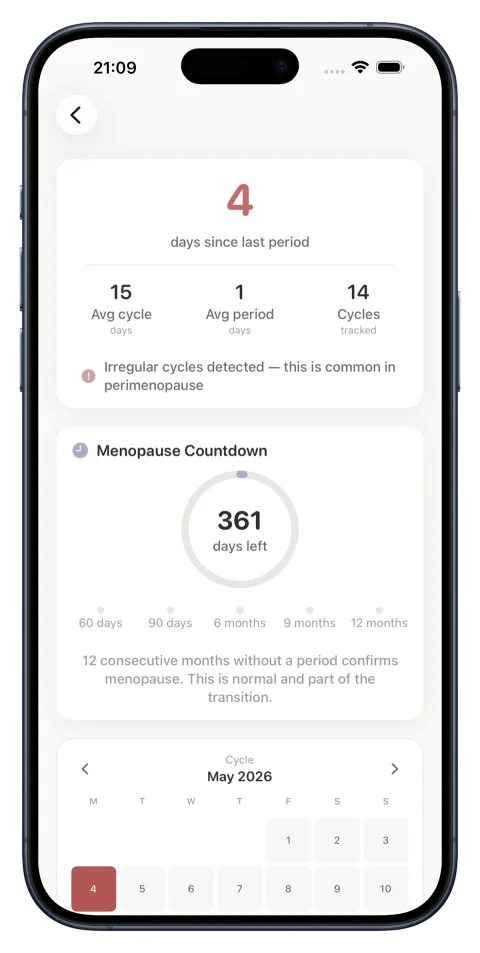
Your period is three weeks late. You are forty-six. The obvious conclusion is that this is the transition finally moving along — and often it is. But a missed period is a symptom, not a diagnosis, and in your forties it has more than one plausible explanation.
This article is for informational purposes only and is not medical advice. Bleeding changes have many causes, and only your healthcare provider can evaluate yours.
Why cycles start skipping
Ovulation is what sets the timing of a period. Roughly two weeks after an egg is released, if there is no pregnancy, progesterone falls and the lining sheds. That interval is reliable; the part before it is not.
As the follicle pool runs low, some cycles simply fail to produce an ovulation. With no ovulation there is no progesterone withdrawal, so no period arrives on schedule. The lining continues to thicken under estrogen until it eventually becomes unstable and sheds on its own — which is why a long-delayed period is frequently a heavy one.
This is why late perimenopause looks the way it does: a 60-day gap, then a heavy period, then two cycles at 30 days, then another long gap.
What else stops periods in your forties
Worth ruling out before settling on perimenopause, particularly when the rest of the picture does not fit:
- Pregnancy. The one to exclude first, every time. Fertility declines but does not switch off, and unpredictable ovulation is still ovulation.
- Thyroid disease. Both under- and overactive thyroid disrupt cycles, and both are more common in midlife. The overlap with perimenopause symptoms — fatigue, weight change, mood, temperature sensitivity — is considerable, which is exactly why it gets missed.
- Marked weight change or heavy exercise. Either can suppress ovulation, in either direction.
- Sustained stress or illness. Enough to delay or prevent ovulation for a cycle or two.
- Medications. Some antidepressants, antipsychotics and steroids affect cycles; hormonal contraception may stop them altogether by design.
- Raised prolactin or PCOS. Less common as a new finding at this age, but part of the standard workup for absent periods.
Reading the twelve-month rule properly
Menopause is defined retrospectively: twelve consecutive months with no bleeding at all. The detail people miss is that the count restarts from zero with any bleeding. Eleven clear months followed by one period puts you back to month zero, which is deflating but clinically meaningful.
It also matters for contraception. If you are over 50, contraception is generally advised until twelve months have passed without a period. Under 50, the usual advice is two years, because ovulation is more likely to reappear.
When a missed period needs attention
| Situation | Reasonable to watch | Get it looked at |
|---|---|---|
| Your age | Over 45 with other transition symptoms | Under 45, and especially under 40 |
| Pregnancy possible | Test negative | Test positive, or unable to rule out |
| Other symptoms | Hot flashes, sleep changes, mood shifts | Milky discharge, headaches, vision change, severe fatigue |
| When it returns | A period after a long gap | Very heavy or prolonged bleeding after the gap |
| After 12 clear months | — | Any bleeding at all, always |
Periods stopping before 45 is worth a proper assessment rather than being filed as early menopause, and before 40 it needs investigation regardless of how well the rest of the picture fits.
Why the dates matter more than you would think
The twelve-month rule only works if you know when you last bled. Most people are confident about the month and wrong about the date, and "some time in the spring, I think" makes the count unusable. The same dates also establish whether you have reached a 60-day gap, which is the marker for late transition.
The Bottom Line
Skipped periods are a normal feature of late perimenopause, caused by cycles in which ovulation does not occur, and a gap of 60 days or more marks that stage. They are not proof of it, though: pregnancy remains possible, and thyroid disease in particular mimics the transition closely enough to be missed. Menopause is confirmed only after twelve consecutive months without bleeding, and any bleeding resets the count — which makes an accurate record of your period dates more useful here than anywhere else in the transition.