Does Exercise Help With Perimenopause Symptoms?
Yes, exercise significantly improves perimenopause symptoms. Strength training (2-3x/week) protects bones and muscle while improving metabolism. Cardio (150 min/week moderate or 75 min vigorous) supports cardiovascular health and mood. Yoga reduces stress and improves sleep. The combination outperforms any single type for overall symptom management.
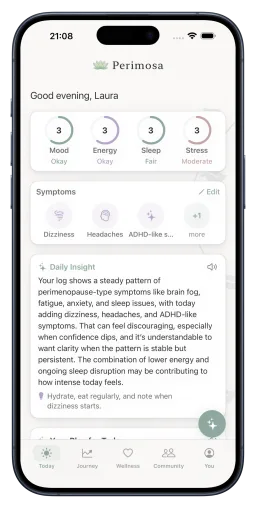
Finally understand what your body is doing
Perimosa logs how you feel each day, finds the pattern, and gives you the words to take to your doctor. Free on iPhone and iPad.
Get the free appStrength Training Is Non-Negotiable
Strength training is the single most impactful exercise type during perimenopause. As estrogen declines, women lose muscle mass faster -- and muscle is metabolically active tissue that supports weight management, bone density, insulin sensitivity, and longevity. Two to three sessions per week of resistance training (free weights, machines, bands, or bodyweight) is the minimum effective dose. Aim for progressive overload -- gradually increasing weight or reps over time. Within 12 weeks most women see noticeable strength gains and body composition improvements.
Cardio for Heart, Mood, and Weight
Aerobic exercise -- walking, cycling, swimming, jogging -- supports cardiovascular health (especially important as estrogen-mediated protection fades), reduces hot flash severity, improves mood through endorphin and serotonin support, and helps with weight management. The current guideline is 150 minutes per week of moderate intensity or 75 minutes of vigorous, ideally spread across most days. Even 10-minute walks accumulated through the day count. Find something you actually enjoy -- consistency beats intensity.
Yoga, Pilates, and Flexibility
Yoga has specific evidence for reducing hot flashes, improving sleep quality, decreasing stress, and easing joint pain. Pilates strengthens core muscles that support posture and reduce low back pain that often emerges with hormonal shifts. Mobility and flexibility work prevent the stiffness many women notice in their 40s. These don't replace strength training and cardio but complement them powerfully. Even 15-20 minutes of yoga 3x per week produces measurable benefits.
Common Mistakes
Over-doing high-intensity cardio without recovery worsens cortisol dysregulation, sleep, and sometimes hot flashes. Skipping strength training because it feels less productive than cardio is the most common mistake. Ignoring rest and recovery -- your body needs more recovery time in perimenopause than it did at 25. Treating exercise as punishment for eating rather than as health support. The exercise that works is the kind you'll do consistently for years; sustainability beats intensity every time.
Specifically What to Do for Each Major Symptom
Different symptoms respond to different exercise prescriptions. Hot flashes: research shows aerobic exercise reduces frequency and severity by 30-40% with 3+ sessions weekly of moderate intensity. Sleep disruption: morning exercise anchors circadian rhythm; evening exercise may disrupt sleep for some. Mood: any consistent exercise improves mood, but strength training has particularly strong evidence for anxiety reduction. Joint pain: counterintuitively, low-impact daily movement plus strength training improves joint pain more than rest. Brain fog: aerobic exercise improves cognitive function within weeks. Weight: strength training plus protein matters more than cardio for body composition. Match your exercise prescription to your worst symptoms rather than doing generic 'cardio for an hour daily.'
How to Track Whether Exercise Is Actually Helping
Exercise produces gradual rather than dramatic changes, so it's easy to lose motivation when you don't 'feel' it working. Tracking systematically in Perimosa solves this. Establish a 2-week baseline of your target symptoms before starting a new exercise routine. After 8 weeks of consistent training, compare your tracked symptoms. Most women see measurable improvement in sleep quality, hot flash frequency, mood, and energy that wasn't obvious in daily perception. This data also helps you stay consistent when motivation flags -- seeing that your hot flashes dropped from 8/day to 4/day after starting strength training is more motivating than a vague sense that you 'feel better.'
What Most Women Do Wrong With Exercise in Perimenopause
Several common mistakes undermine results. Doing only cardio and skipping strength training -- this preserves cardiovascular fitness but doesn't address the muscle loss driving most perimenopausal metabolic changes. Over-doing high-intensity work without recovery -- chronic stress on an already-elevated cortisol system worsens sleep, mood, and hot flashes. Pushing through severe fatigue rather than scaling back during particularly hard weeks -- this triggers burnout and quitting. Treating exercise as punishment for eating rather than as health support. Believing more is always better -- 4 sessions weekly produces 90% of the benefit of 6, with much better adherence.
Bottom Line
Exercise is one of the highest-leverage interventions for perimenopause -- second only to sleep in overall impact. The optimal prescription: 2-3 strength training sessions weekly (non-negotiable for muscle preservation and bone density), 150 minutes of moderate cardio weekly (or 75 minutes vigorous), and ideally some yoga or flexibility work. Match specific exercise types to your worst symptoms. Track results in Perimosa over 8-12 weeks to confirm what's working. Find what you'll actually do consistently -- sustainability matters more than intensity. And don't skip strength training because cardio feels more productive; strength is the keystone exercise during this transition.
References
Medical disclaimer: This article is for informational purposes only and does not constitute medical advice. Always consult a qualified healthcare provider for diagnosis and treatment decisions. Perimosa is a symptom tracking tool, not a medical device.