Plenty of women expect perimenopause to mean periods fading out. For a great many it is the opposite first: heavier, longer, more sudden, occasionally alarming. Flooding through clothes at work, planning a day around proximity to a bathroom, keeping a spare set of everything in the car. It is one of the most disruptive symptoms of the transition and one of the least talked about.
It is also, usually, explicable and treatable.
This article is for informational purposes only and is not medical advice. Bleeding changes have many causes, and only your healthcare provider can evaluate yours.
Why perimenopause makes bleeding heavier
The short answer is missing progesterone.
In an ovulatory cycle, the ovary releases an egg and the remaining follicle produces progesterone, which stabilises the uterine lining and caps its growth. Around the middle of perimenopause, ovulation becomes intermittent. In a cycle where it does not happen, there is no progesterone — but estrogen carries on, and estrogen builds lining.
The lining therefore grows thicker than usual and for longer than usual, until it becomes unstable and sheds all at once. More tissue means more bleeding, more clotting, and a period that arrives with much less warning.
Two other things common at this age compound it:
- Fibroids. Benign muscular growths in the uterine wall, most prevalent in the forties. Those that distort the uterine cavity cause markedly heavier bleeding.
- Polyps. Small overgrowths of the lining itself, which bleed readily and often cause spotting between periods as well.
What actually counts as heavy
Most women have no idea whether their bleeding is unusual, because nobody compares. The clinical definition is deliberately practical:
- Soaking through a pad or tampon every hour for several consecutive hours
- Needing to double up — a tampon and a pad together
- Waking at night to change protection
- Passing clots larger than a coin
- Bleeding for more than seven days
- Restricting what you do because of the flow
Any one of those meets the threshold. The last is the one women discount most readily, and it is the one that best captures the real cost.
The part that gets missed: iron
Heavy cycles month after month deplete iron stores slowly, and the resulting symptoms — exhaustion, breathlessness on stairs, brain fog, poor tolerance of cold — look exactly like perimenopause. So they get attributed to perimenopause, and the anaemia goes unaddressed for a year or more.
If your periods are heavy, it is reasonable to ask for a full blood count and a ferritin level specifically. Ferritin reflects stored iron and can be low well before haemoglobin falls, which is precisely the window in which you feel awful and a standard blood count still reads normal.
When heavy bleeding needs prompt attention
| Feature | Common in perimenopause | See someone |
|---|---|---|
| Flow | Heavier than it used to be | Hourly soaking for several hours |
| Duration | Up to about 7 days | Beyond 7 days, repeatedly |
| Between periods | Occasional light spotting | Repeated bleeding between periods or after sex |
| How you feel | Tired around your period | Dizzy, breathless, heart racing, persistently exhausted |
| After menopause | — | Any bleeding, always, without delay |
Bleeding heavily enough to feel faint, breathless or newly unwell is urgent rather than routine, and is a reason to be seen the same day.
What your doctor is likely to do
New heavy bleeding in your forties is investigated before it is treated. Typically that means a pelvic examination, a full blood count and ferritin, a pelvic ultrasound to look for fibroids or polyps and to measure the lining, and — where the lining is thickened, bleeding is irregular, or there are risk factors — a biopsy of the lining. The biopsy is a brief outpatient procedure and is done to exclude the uncommon causes rather than because they are expected.
What helps
- Hormonal IUD. Usually offered first. It thins the lining and substantially reduces flow for most women, and provides contraception, which is still needed.
- Tranexamic acid. Taken only on bleeding days, non-hormonal, and it reduces flow meaningfully. A good option if you would rather not use hormones.
- Anti-inflammatories. Naproxen or mefenamic acid taken during the period reduce both flow and cramping.
- Cyclical progestogen or combined contraception. Restores the progesterone that anovulatory cycles are missing, making bleeding lighter and more predictable.
- Procedures. Where fibroids or polyps are the cause, removing them is often definitive. Endometrial ablation is an option for women who have completed their families.
- Iron. Replacement if stores are low, which is common and frequently the change women notice most.
Getting through the months while it is being sorted out
Investigation and treatment take time, and in the meantime there are heavy days to be managed. What women who have been through it tend to recommend:
- Higher-capacity protection. Menstrual cups and discs hold considerably more than a tampon and can be worn longer, which matters most on the days when hourly changes are otherwise unavoidable. Period underwear works well as a backup layer rather than as the only line of defence.
- Plan around the pattern, not the calendar. Once you know which days of your period are the heavy ones, the worst of the disruption is predictable even when the cycle is not.
- Iron-rich food is useful but rarely sufficient. If your stores are genuinely low, diet alone tends not to close the gap; supplementation is what shifts it, and it is worth testing rather than guessing.
- Anti-inflammatories started early. Taken at the very beginning of a period rather than once it is established, naproxen or mefenamic acid reduce flow as well as cramping.
- Do not normalise it. Heavy bleeding is so widely treated as an unavoidable part of being a woman in her forties that women routinely tolerate months of it. It is a treatable symptom, and the fact that it is common does not make it something to absorb.
Tracking that makes the appointment work
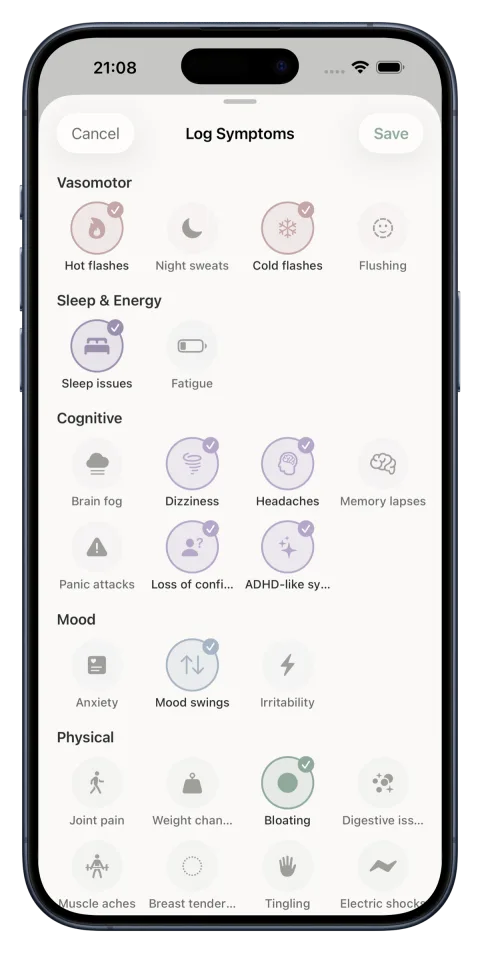
Consultations for heavy bleeding go badly when they rely on memory, because memory flattens. Useful specifics are: how many days you bled, how many of those were heavy, how often you changed protection on the worst day, whether clots appeared and roughly how large, and whether you bled between periods.
That is a short list, and it converts an unanswerable question — "are your periods heavy?" — into something a clinician can act on immediately.
The Bottom Line
Heavy periods in perimenopause are driven mainly by cycles without ovulation, in which the lining builds up unopposed by progesterone, often with fibroids or polyps contributing. It meets the definition of heavy if you soak hourly for several hours, pass coin-sized clots, bleed beyond seven days, or organise your life around it. Iron deficiency is a common and frequently missed consequence. None of this is something to wait out until periods stop on their own — it is investigated, and there are several effective treatments.