Can Magnesium Help With Perimenopause?
Yes, magnesium can help with several perimenopause symptoms including sleep difficulties, anxiety, muscle tension, headaches, and PMS. Magnesium glycinate is the best-absorbed form and least likely to cause digestive issues. Typical dose is 200-400mg in the evening. Allow 4-6 weeks of consistent use to evaluate effect.
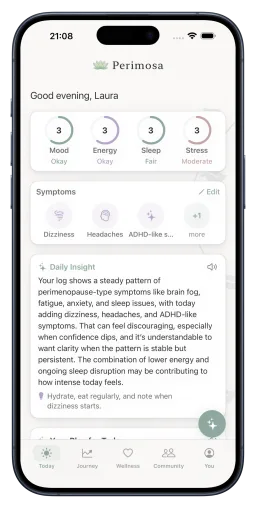
Finally understand what your body is doing
Perimosa logs how you feel each day, finds the pattern, and gives you the words to take to your doctor. Free on iPhone and iPad.
Get the free appWhy Magnesium Matters in Perimenopause
Magnesium is involved in 300+ enzymatic reactions in the body, including those that regulate the nervous system, sleep, muscle function, blood sugar, and stress response. Many women are mildly deficient because soil depletion and modern diets often don't provide enough. Estrogen affects magnesium metabolism, so as estrogen fluctuates, magnesium needs can increase. Symptoms of inadequate magnesium overlap heavily with perimenopause: poor sleep, anxiety, muscle cramps, headaches, constipation, fatigue.
What the Evidence Supports
Magnesium has solid evidence for improving sleep quality (especially when paired with consistent sleep habits), reducing anxiety symptoms in mild-to-moderate cases, easing muscle tension and cramps, helping with constipation (citrate form), and reducing migraine frequency in people prone to them. It does not have strong evidence for directly reducing hot flashes, though some women report improvement -- likely through better sleep and lower stress.
Which Form to Choose
Form matters significantly for absorption and effects. Magnesium glycinate is well-absorbed, gentle on digestion, and best for sleep, anxiety, and general supplementation. Magnesium citrate is decent absorption but can loosen stools -- useful if constipation is an issue. Magnesium oxide is poorly absorbed and mostly worth skipping. Magnesium L-threonate may have better brain absorption -- helpful for cognitive symptoms but more expensive. Magnesium chloride (topical sprays) has weaker evidence than oral forms for systemic effects.
How to Take It
Start with 200mg in the evening 30-60 minutes before bed. If well-tolerated and you want more effect, you can increase to 400mg over a few weeks. Take consistently for at least 4 weeks to evaluate benefit -- magnesium effects build over time, not in a single dose. Side effects are minimal but can include loose stools (especially with citrate). Magnesium can interact with certain medications including antibiotics, blood pressure medications, and diuretics -- check with your doctor if you take prescription medications.
Specific Symptoms Magnesium Helps Most With
Magnesium's benefits aren't uniform across all perimenopause symptoms -- it works better for some than others. Strongest evidence: sleep quality (particularly difficulty staying asleep), anxiety in mild-to-moderate cases, muscle tension and cramps, headaches and migraines, constipation. Moderate evidence: mood support, PMS, restless legs. Weaker evidence: direct effect on hot flashes (helps some women indirectly through better sleep but isn't a primary intervention). If your worst symptom is severe hot flashes, magnesium alone isn't the answer. If your worst symptoms are sleep, anxiety, and muscle tension, magnesium is one of the highest-value single supplements you can add.
How to Test If It's Actually Working for You
Because magnesium effects build gradually, women often miss whether it's helping them. Structured testing solves this. Track in Perimosa for 2 weeks before starting magnesium: sleep quality (hours, awakenings, restorative feel), anxiety (0-10 scale), muscle tension, and any other target symptoms. Start with 200mg magnesium glycinate at night. Take consistently for 4-6 weeks (effects build, not immediate). Compare your tracked symptoms before vs after. If you see clear improvement, continue. If not, try 400mg for another 4 weeks. If still no effect, it's probably not your bottleneck nutrient and you can stop. This structured approach prevents years of taking supplements that aren't doing anything.
Common Magnesium Mistakes
Several mistakes reduce magnesium's effectiveness. Taking magnesium oxide (poorly absorbed) instead of glycinate -- the bottle says 'magnesium' but you're absorbing barely any. Taking it irregularly -- magnesium builds tissue levels over weeks, so daily consistency matters. Taking it at the wrong time -- best taken in the evening for sleep benefit, not morning. Taking it with calcium supplements -- they compete for absorption. Mega-dosing 600+mg, which causes loose stools without additional benefit. Expecting immediate effects -- meaningful sleep improvement usually takes 2-4 weeks of consistent use. Taking magnesium while continuing factors that deplete it (excess alcohol, caffeine, chronic stress).
Bottom Line
Magnesium is one of the better-supported supplements for perimenopause, particularly for sleep, anxiety, muscle tension, and headaches. Choose magnesium glycinate for best absorption and minimal digestive side effects. Take 200-400mg in the evening, consistently, for 4-6 weeks before evaluating effect. Track your target symptoms before and during supplementation in Perimosa so you can measure actual benefit. It's not a hot flash cure, and it's not a substitute for HRT in severe cases -- but for the right symptoms, it's a high-leverage, low-cost intervention worth trying.
References
Medical disclaimer: This article is for informational purposes only and does not constitute medical advice. Always consult a qualified healthcare provider for diagnosis and treatment decisions. Perimosa is a symptom tracking tool, not a medical device.