How Do I Deal With Perimenopause Rage?
Perimenopause rage is real and caused by hormonal shifts affecting the brain's emotional regulation systems. Strategies that help include tracking triggers, prioritizing sleep, reducing alcohol, daily stress practices, strength training, and considering CBT or medication when rage interferes with relationships. You're not a bad person -- this is biology.
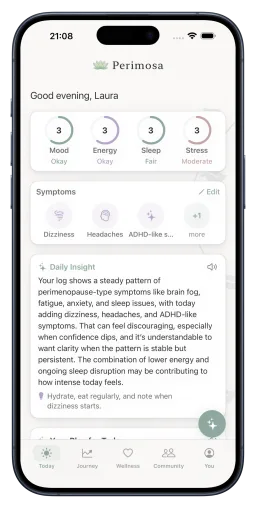
Finally understand what your body is doing
Perimosa logs how you feel each day, finds the pattern, and gives you the words to take to your doctor. Free on iPhone and iPad.
Get the free appWhy Rage Is Different in Perimenopause
Perimenopause rage isn't the same as ordinary anger. It can erupt over things that wouldn't have bothered you a year ago, escalate faster than you can control, and feel almost foreign -- like watching yourself react. The cause is hormonal: estrogen normally boosts serotonin and GABA, the neurotransmitters that help you regulate emotional intensity. When estrogen swings dramatically, those buffers weaken. You're not becoming a bad person -- the emotional brake pads are temporarily less effective.
Identify Your Triggers
Most rage episodes have triggers, even when they feel random. Common ones in perimenopause: being interrupted, feeling unheard, being overwhelmed by competing demands, hunger (low blood sugar triggers anger fast), sleep deprivation, hormonal low points in your cycle, alcohol the night before, and accumulated unaddressed frustration. Track your rage episodes for 2-3 weeks alongside your cycle, sleep, food, and circumstances. Patterns emerge that you can then proactively manage.
In-the-Moment Strategies
When rage rises: physically leave the situation if possible, even briefly. Breathe deeply -- the slow exhale activates the parasympathetic nervous system. Splash cold water on your face -- it interrupts the physiological cascade. Wait 90 seconds before responding; the initial chemical surge passes within that window if you don't feed it. Speak slowly and quietly, not just because of others but because it slows you. Tell people who matter to you what's happening -- 'I need 10 minutes' is more honest than exploding.
Longer-Term Solutions
Foundations matter most. Consistent sleep, regular meals with adequate protein, daily movement, and reduced alcohol all stabilize the systems that fail during rage. CBT specifically for emotional regulation has strong evidence. Mindfulness practice over months changes how reactively you respond to triggers. Medication is worth considering when rage damages relationships or work -- SSRIs or HRT can dramatically reduce hormonally-driven anger. None of this means accepting the rage as your new identity. It's a phase, and it responds to treatment.
The Pattern That Catches Most Rage Triggers
Rage episodes feel random until you start tracking them. Then patterns emerge fast. Most common: rage spikes in the late luteal phase (days 7-3 before period) and around ovulation. A second pattern: rage is dramatically worse on days after alcohol consumption, even moderate. A third: rage correlates strongly with sleep -- poor nights are followed by lower thresholds. A fourth: hunger, especially low blood sugar, triggers rage faster than people realize. Logging rage episodes in Perimosa with cycle phase, sleep quality, food timing, and alcohol over 4 weeks usually reveals 2-3 clear personal triggers. Knowing them is half the battle -- predictable rage is manageable in ways that random rage isn't.
What to Say to People You Love When This Happens
Rage damages relationships not because rage exists but because of what gets said in the moment and what doesn't get repaired afterward. Useful scripts: 'I'm feeling reactive right now -- I need 20 minutes alone before we keep talking.' 'I'm in a hormonal storm phase and might be more on edge this week.' 'That reaction earlier was disproportionate, and I'm sorry.' Pre-arrange a signal with your partner that means 'I need space immediately.' Practice apologizing without excessive self-flagellation -- a clean 'I overreacted, I'm sorry' is more useful than long explanations. Repair conversations after rage are often more relationship-strengthening than no rage at all.
When Rage Means It's Time for Medical Help
Some rage is manageable with foundation work alone. Other patterns warrant medical intervention. Time to escalate to your doctor: when rage damages important relationships repeatedly, when it affects work performance, when you have intrusive thoughts of harm (to yourself or others), when it's accompanied by hopelessness or severe depression, when you don't recognize yourself, when alcohol use is escalating to cope. HRT often resolves hormonally-driven rage dramatically. SSRIs help when rage co-exists with depression or anxiety. CBT specifically for emotional regulation has strong evidence. This isn't weakness -- it's responding appropriately to a real biological challenge with effective tools.
Bottom Line
Perimenopausal rage is biological, time-limited, and treatable. The intensity comes from estrogen's effects on the brain's emotional regulation systems combined with sleep deprivation, hunger, alcohol, and accumulated stress. The path through it: track patterns in Perimosa for 4 weeks to identify your specific triggers; eliminate alcohol or dramatically reduce it; protect sleep ferociously; eat regularly with adequate protein; build in daily stress practices; learn and practice in-the-moment de-escalation techniques. If rage damages relationships or work, escalate to medical help -- HRT, SSRIs, and CBT all work. This is a phase, not your new identity, and it responds to treatment.
References
Medical disclaimer: This article is for informational purposes only and does not constitute medical advice. Always consult a qualified healthcare provider for diagnosis and treatment decisions. Perimosa is a symptom tracking tool, not a medical device.