How Does Perimenopause Affect Relationships?
Perimenopause significantly affects relationships through mood swings, libido changes, sleep disruption, irritability, and emotional volatility. Open communication, education for partners, addressing symptoms medically when needed, and prioritizing connection during a hard phase all help. Many relationships emerge stronger after navigating the transition together.
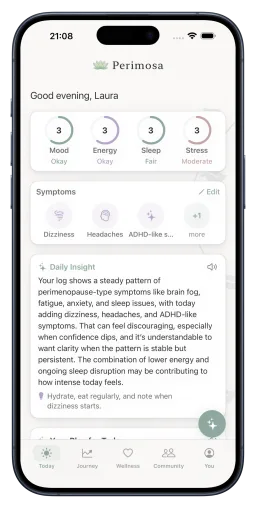
Finally understand what your body is doing
Perimosa logs how you feel each day, finds the pattern, and gives you the words to take to your doctor. Free on iPhone and iPad.
Get the free appWhy It Hits Relationships Hard
Perimenopause produces several changes that ripple through relationships. Mood swings and irritability mean reactions that feel disproportionate to small triggers. Sleep deprivation reduces patience and emotional capacity. Libido changes can create tension and avoidance around physical intimacy. Hot flashes and night sweats disrupt shared sleep. Brain fog affects memory of conversations and commitments. Confidence and identity shifts can change how women show up. None of this means relationships are broken -- but they need active navigation.
What Partners Often Don't Understand
Partners who haven't experienced this often don't grasp how fundamentally different the experience is from previous moodiness or PMS. The intensity, unpredictability, and physical reality of perimenopause requires education -- ideally from credible sources, not just frustrated explanations during conflicts. Partners reading a single good article or book about perimenopause often shifts the dynamic significantly. Resources like Dr. Mary Claire Haver's work, Dr. Jen Gunter's writing, and balanced documentaries help partners understand they're dealing with biology, not personality change.
Communication That Helps
Specific communication strategies make a meaningful difference. Name the season: 'I'm in perimenopause, and these are the changes I'm experiencing.' Be specific about what you need: 'I need 30 minutes alone after work to decompress' is more useful than 'leave me alone.' Address libido honestly without making it about rejection. Apologize when reactions were disproportionate -- accountability strengthens relationships even when biology is part of the cause. Ask for specific support rather than expecting your partner to guess.
When to Seek More Help
Some couples benefit from therapy together to navigate this transition, especially when patterns of conflict have intensified. Individual therapy can help process the identity shifts and emotional load. Treatment for severe symptoms -- HRT, antidepressants, sleep interventions -- often improves relationship quality dramatically by reducing the symptom intensity that's straining the partnership. Don't wait until the relationship is in crisis. Many women report their relationships are stronger after the transition because they had to communicate at a deeper level.
The Patterns That Damage Relationships Most
Several specific patterns most reliably damage relationships during perimenopause. Untreated severe symptoms accumulate strain over months, slowly eroding connection. Communication breakdowns where neither partner names what's happening. Partners taking emotional reactions personally rather than recognizing biology. The 'silent suffering' pattern where the perimenopausal woman doesn't ask for help and resents the lack of it. Avoidance of physical intimacy without explanation. Comparison to how the relationship 'used to be' rather than adapting to current reality. Naming these patterns when you see them is the first step toward changing them. Many relationships emerge stronger after navigating perimenopause together precisely because they had to learn deeper communication.
What Partners Actually Need to Hear
Most partners want to support but don't know how. Specific things that help when you tell them: 'This is a temporary phase, not a permanent change.' 'When I react disproportionately, it's usually hormones plus exhaustion, not actually about you.' 'I need [specific thing] -- 20 minutes alone after work, no questions during a hot flash, extra patience in the late luteal phase.' 'You can't fix this for me but you can help by [specific action].' 'I'll tell you when something is reaching a crisis point.' Specific scripts beat general 'be understanding' pleas. Most partners respond well when given concrete ways to help.
Using Tracking to Bridge the Communication Gap
Tracking symptoms in Perimosa gives partners visibility into something that feels invisible to them. Some women share their tracked data with their partner directly -- 'You can see I've had a rough sleep week and we're approaching my hardest cycle days.' Others use the data themselves to predict and communicate ahead: 'My pattern shows my hardest days are typically days 24-28 of my cycle, so I might need extra space then.' Either way, the data converts vague 'I'm having a hard time' into concrete patterns the partner can understand and prepare for. This shifts dynamics from reactive to predictive.
Bottom Line
Perimenopause significantly affects relationships through mood instability, sleep disruption, libido changes, and emotional volatility -- but it doesn't have to damage them long-term. Specific interventions help: education for the partner about what's biologically happening, clear communication about what you need (in specific scripts, not vague hopes), tracking patterns to enable prediction rather than reactivity, addressing symptoms medically when they're severe enough to strain the relationship, and considering couples therapy if patterns of conflict have deepened. Many relationships emerge stronger because they were forced to communicate at a deeper level than they had before.
References
Medical disclaimer: This article is for informational purposes only and does not constitute medical advice. Always consult a qualified healthcare provider for diagnosis and treatment decisions. Perimosa is a symptom tracking tool, not a medical device.