How to Talk to Your Partner About Perimenopause
Talk to your partner about perimenopause directly and specifically. Name the season ('I'm in perimenopause'), describe what you're experiencing, share what you need, and give them resources to understand the biology. Choose a calm moment, not during conflict. Most partners want to help once they understand what's actually happening.
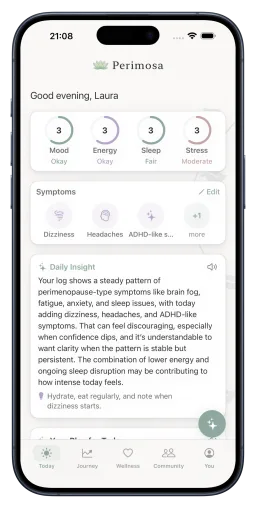
Finally understand what your body is doing
Perimosa logs how you feel each day, finds the pattern, and gives you the words to take to your doctor. Free on iPhone and iPad.
Get the free appPick the Right Moment
The wrong time is mid-conflict, mid-hot-flash, or while you're sleep-deprived and on edge. Choose a calm moment: a weekend morning, a walk together, or after a good meal. Frame it as something important you want to share, not a complaint or accusation. 'I want to tell you what's happening with my body and what I need from you' opens better than 'we need to talk' (which signals impending bad news). Give the conversation 30-60 minutes of focused attention.
What to Actually Say
Be direct and specific. Name the season: 'I'm in perimenopause -- the years before menopause when hormones fluctuate dramatically.' Describe your specific experience: 'My sleep is fragmented because of night sweats. My mood swings feel out of my control sometimes. My libido has changed and it's not about you.' Acknowledge the impact on them: 'I know I've been less patient lately, and I'm sorry when that's landed on you.' This isn't weakness -- it's leadership in the relationship.
Give Them Resources
Most partners genuinely want to help but lack context. Share a credible book or article (Dr. Mary Claire Haver, Dr. Jen Gunter, or 'The Menopause Manifesto' are good starts). Send a podcast episode they can listen to during a drive. Show them the medical reality: this affects 80% of women, lasts an average of 7 years, and is biologically driven. Partners who read or listen to even one good resource often have an 'aha' moment that shifts the dynamic. You don't need to be the only educator.
Tell Them What You Need
Don't expect your partner to guess. Be specific: 'When I'm having a rough day, I need 30 minutes alone to reset before we talk about logistics.' 'On nights I sweat a lot, I might need to sleep in the cool room.' 'Physical affection without expectation of sex matters to me right now.' 'When I'm irritable, please don't take it personally -- it usually passes within an hour.' Specific asks are easier to meet than vague hopes. Update what you need as it changes.
A Sample Conversation Script That Works
Here's a script many women have used successfully. 'I want to share something with you. I've realized I'm in perimenopause -- the years before menopause when hormones fluctuate dramatically. Here's what that means for me: my sleep has been fragmented because of night sweats, my moods have been more volatile than I'd like, my energy is lower, and I've had some symptoms I didn't expect like brain fog and anxiety. None of this is about you or about us. It's a biological transition that lasts a few years. I want to tell you specifically because [reason: I need your support / I want you to understand what's happening / I want us to navigate this together]. Here's what would help me most: [3 specific things].' Adjust to fit your relationship and what you actually need.
How to Handle Common Partner Reactions
Partners react in predictable ways and being prepared helps. Reaction: 'But you're too young for menopause.' Response: 'Perimenopause is the years before menopause -- I'm typical age for it.' Reaction: 'My mom never complained about this.' Response: 'Many women were taught not to talk about it. The research now shows it affects 80% of women significantly.' Reaction: 'Can't you just power through?' Response: 'I am powering through, and I'm asking for specific support to make that more sustainable.' Reaction: 'Should you go on hormones?' Response: 'That's a decision I'm thinking through. For now, here's what would help.' Reaction: 'I don't know what to say.' Response: 'You don't need to fix it. Just understanding is most of what I need.'
Showing Them the Data
Some partners shift dramatically when shown actual tracked data rather than vague descriptions. Tracking your symptoms in Perimosa over a few months gives you the option to share specifics: 'Look at this -- I had 8 hot flashes today and 5 yesterday. My sleep score has averaged 4/10 this week. My mood ratings drop predictably around days 24-28 of my cycle.' Concrete data lands differently than 'I feel terrible' for many partners, especially analytically-oriented ones. This isn't about proving you're suffering -- it's about making the invisible visible so they can support you accurately. Some women share data weekly; others share screenshots during particular conversations. Find what works for your relationship.
Bottom Line
Talking to your partner about perimenopause directly and specifically transforms how they can support you. Pick a calm moment, name the season clearly, describe your specific experience, give them resources to understand the biology, and tell them exactly what you need. Don't expect them to guess. Have prepared responses for common reactions. Share tracked data if it helps them understand. Most partners genuinely want to help once they understand what's actually happening -- the difficulty is bridging the gap between your invisible experience and their visible relationship. Most couples emerge stronger from this conversation than they were before.
References
Medical disclaimer: This article is for informational purposes only and does not constitute medical advice. Always consult a qualified healthcare provider for diagnosis and treatment decisions. Perimosa is a symptom tracking tool, not a medical device.