How Long Does Early Perimenopause Last?
Early perimenopause typically lasts 4-7 years before transitioning to the late stage. During this phase, cycles vary in length by 7+ days, FSH levels rise variably, and symptoms are usually mild but persistent. Some women experience an even longer early phase -- up to 10 years for those who start in their late 30s.
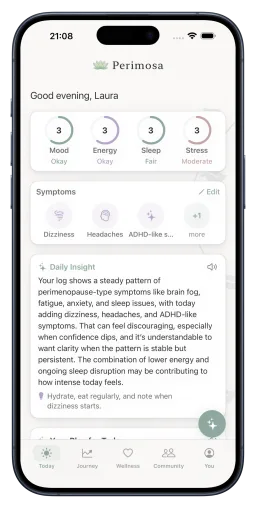
Finally understand what your body is doing
Perimosa logs how you feel each day, finds the pattern, and gives you the words to take to your doctor. Free on iPhone and iPad.
Get the free appDefining Early Perimenopause
Early perimenopause is the first formally recognized stage of the menopausal transition. It begins when your cycles start varying by 7 or more days from your typical pattern -- not a single off cycle, but a consistent pattern of variability. Most cycles still occur, just with more variation. Internally, ovarian follicles are declining, FSH is rising, and progesterone is typically the first hormone to drop. This phase ends when periods start being skipped (60+ day gaps), marking the start of late perimenopause.
Why It Lasts So Long
Four to seven years feels long because your body is making a gradual, complex transition rather than a sudden switch. Ovarian decline isn't linear -- it accelerates and slows in waves. Some months you ovulate normally, others you don't. Hormones swing dramatically. The body slowly adapts. This extended timeline is actually protective -- it gives your other systems (cardiovascular, skeletal, neurological) time to adjust to lower estrogen rather than facing an abrupt drop.
Symptoms in This Phase
Early perimenopause symptoms are typically more subtle than what comes later: worsened PMS, slight changes in flow or cycle length, sleep that's not quite as deep, mild mood swings, occasional brain fog, and the appearance of new symptoms like anxiety or breast tenderness. Hot flashes can start in this phase but are often mild and infrequent. The cumulative effect over years adds up, which is why many women feel like they slowly drift away from their previous baseline.
Why Tracking Matters
Because early perimenopause unfolds slowly, day-to-day changes feel insignificant. But systematic tracking over months reveals patterns that single moments miss. Cycle length variation, the emergence of new symptoms, intensity of PMS -- all of these become clearer when logged consistently. This longitudinal data is also what doctors need to validate early perimenopause when blood tests alone aren't conclusive. The earlier you start tracking, the better the picture you'll have over the next decade.
Why Early Perimenopause Feels So Confusing
The thing that makes early perimenopause uniquely disorienting is that nothing feels clearly wrong, but nothing feels right either. Cycles look normal but feel different. Sleep happens but isn't restorative. Moods shift without obvious cause. PMS that you handled fine for 20 years suddenly feels overwhelming. Many women describe a sense of 'losing themselves' without being able to point to specific changes. This vagueness is exactly why early perimenopause goes undiagnosed for so long. The symptoms aren't dramatic enough to demand attention but accumulate week over week into something that genuinely affects quality of life.
What Tracking Reveals in Early Perimenopause
Tracking systematically during early perimenopause shows you things you'd otherwise miss. Cycle length variability becomes visible -- the 28-day cycles you remember are now 25, 32, 27, 31. Symptoms cluster by cycle phase in ways you couldn't see without data. Sleep quality degrades during specific phases. Mood patterns emerge. Tracking in Perimosa for 6+ months during early perimenopause builds the longitudinal record that validates the diagnosis when blood tests are inconclusive, and helps your doctor see the trajectory rather than just a snapshot. This is also when foundational habits matter most -- you're laying the groundwork for the harder phases ahead.
Decisions Worth Making in Early Perimenopause
Several decisions are easier to make in early perimenopause than later. Strength training and bone-protecting habits started now compound over a decade. Protein intake patterns established now serve you through the entire transition. Sleep optimization habits built now will be critical when night sweats arrive. Stress management practices learned now become muscle memory before you need them most. Reducing alcohol gradually now is easier than during a crisis. Talking to a menopause-trained doctor now (before symptoms peak) lets you make informed decisions about HRT timing rather than scrambling when severe symptoms hit.
Bottom Line
Early perimenopause typically lasts 4-7 years and is the foundation for everything that follows. Symptoms are usually mild but persistent, easy to dismiss but cumulatively significant. The right move is to take it seriously now: track systematically, build foundational health habits, find a doctor who takes perimenopause seriously, and don't wait for severity to peak before learning your options. The work you do in early perimenopause directly determines how hard the rest of the transition becomes -- and how well-prepared you are when symptoms intensify.
References
Medical disclaimer: This article is for informational purposes only and does not constitute medical advice. Always consult a qualified healthcare provider for diagnosis and treatment decisions. Perimosa is a symptom tracking tool, not a medical device.