What Are the Four Stages of Perimenopause?
The four stages of perimenopause come from the STRAW staging system: early menopausal transition (cycles slightly irregular), late menopausal transition (60+ day gaps), early postmenopause (first year after final period), and late postmenopause (1+ years after final period). Each stage has distinct hormonal patterns and symptoms.
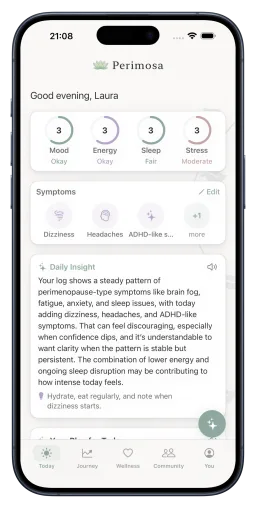
Finally understand what your body is doing
Perimosa logs how you feel each day, finds the pattern, and gives you the words to take to your doctor. Free on iPhone and iPad.
Get the free appStage 1: Early Menopausal Transition
This is the earliest formally recognized stage of perimenopause. Cycles vary in length by 7+ days from your normal pattern -- if your cycle was always 28 days, you start seeing some that are 21 days and others that are 35. Most periods still occur regularly. FSH levels are elevated but still variable. Symptoms are typically mild: occasional sleep issues, PMS intensifying, subtle mood shifts. This stage can last 4-7 years. Most women don't realize they're in perimenopause yet.
Stage 2: Late Menopausal Transition
This stage is defined by skipped periods -- specifically, at least one gap of 60 days or more between cycles. Hot flashes and night sweats become common (75% of women experience them). Sleep disruption intensifies. Vaginal dryness may appear. FSH rises more steadily, estrogen drops more consistently. This stage typically lasts 1-3 years before the final menstrual period. Symptoms often peak in this stage, which is when most women seek medical help.
Stage 3: Early Postmenopause
Once you've gone 12 months without a period, you've entered early postmenopause. This stage lasts about 5-8 years after your final menstrual period. Hot flashes typically continue but often gradually decrease in frequency. Bone density loss is at its fastest in the first 2-3 years. Genitourinary symptoms (vaginal dryness, urinary issues) tend to worsen during this stage if untreated. This is when long-term health risks (cardiovascular, osteoporosis) become priorities to manage.
Stage 4: Late Postmenopause
This stage begins approximately 5-8 years after your final period and continues for the rest of your life. Most vasomotor symptoms (hot flashes, night sweats) have diminished significantly by this point, though some women experience them indefinitely. Genitourinary symptoms typically persist if not treated. Body composition and metabolism have stabilized in their new post-menopausal pattern. The focus shifts entirely to long-term health: bone density, heart health, cognitive function, and quality of life maintenance.
Why the STRAW System Was Created
The STRAW (Stages of Reproductive Aging Workshop) staging system was developed in 2001 and updated in 2011 to give clinicians and researchers a shared framework for describing where a woman is in her reproductive transition. Before STRAW, terms like 'perimenopausal,' 'premenopausal,' and 'climacteric' were used inconsistently, making research comparisons difficult. STRAW divides the female reproductive lifespan into reproductive years, menopausal transition (early and late), and post-menopause (early and late) based on specific cycle and biomarker criteria. Knowing which stage you're in helps your doctor anticipate what's coming, what treatments are appropriate, and when long-term health screening should intensify.
How to Know Which Stage You're In
Without a clear sense of which stage you're in, treatment decisions become guesswork. The simplest way to identify your stage is consistent cycle tracking over time. Early menopausal transition: cycles vary by 7+ days from your norm but you still get periods most months. Late menopausal transition: at least one gap of 60+ days between periods. Post-menopause: you've had 12 consecutive months without a period. Tracking in Perimosa for 6-12 months gives you the cycle data your doctor needs to place you precisely. Blood tests (FSH, AMH) can support but not replace cycle history, because hormone levels fluctuate dramatically during the transition itself.
Stage-Specific Health Priorities
Each stage has different health priorities worth knowing. In early transition, focus on building strength and bone density habits, ensuring vitamin D sufficiency, and addressing emerging symptoms before they become severe. In late transition, the window for HRT initiation is most beneficial -- discussing it now rather than waiting often produces better outcomes. In early post-menopause (first 5 years), bone density loss is fastest and cardiovascular risk increases noticeably -- this is when bone density screening, lipid panels, and cardiovascular risk assessment should intensify. In late post-menopause, the focus shifts to long-term maintenance: continued strength training, cognitive engagement, and routine health screenings.
Bottom Line
The four stages of perimenopause give structure to a transition that otherwise feels chaotic. Knowing roughly which stage you're in helps you anticipate symptoms, prioritize the right interventions, and make informed treatment decisions. Track your cycles and symptoms systematically -- this is the primary data your doctor uses to place you. The stages aren't rigid boxes -- some women linger in one for years, others transition quickly. Use the framework as a guide, not a prediction. The most important takeaway: each stage has different priorities, and matching your interventions to your stage produces better outcomes than treating perimenopause as a monolith.
References
Medical disclaimer: This article is for informational purposes only and does not constitute medical advice. Always consult a qualified healthcare provider for diagnosis and treatment decisions. Perimosa is a symptom tracking tool, not a medical device.