What Causes Hot Flashes During Perimenopause?
Hot flashes are caused by fluctuating estrogen disrupting the hypothalamus -- your brain's temperature control center. The narrowed thermoneutral zone makes the body interpret minor temperature changes as overheating, triggering a sudden vasodilation, sweating, and flushing response. Triggers include stress, caffeine, alcohol, spicy food, and warm environments.
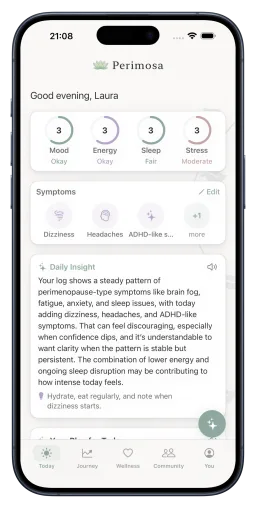
Finally understand what your body is doing
Perimosa logs how you feel each day, finds the pattern, and gives you the words to take to your doctor. Free on iPhone and iPad.
Get the free appThe Hypothalamic Thermostat
Your hypothalamus regulates body temperature with remarkable precision -- normally tolerating a wide thermoneutral zone before triggering cooling or warming responses. Estrogen helps keep this zone broad. As estrogen fluctuates during perimenopause, the thermoneutral zone narrows dramatically. Now even small increases in core temperature -- from a warm room, mild exertion, or stress -- can trip the cooling alarm. Your body responds by dilating blood vessels and sweating to dump heat, producing the classic hot flash.
The KNDy Neuron Discovery
Research over the past decade identified specific brain cells called KNDy neurons that become hyperactive when estrogen drops. These neurons send signals to the hypothalamus that trigger hot flashes. This discovery led to the first non-hormonal medication specifically targeting hot flashes -- fezolinetant (Veozah) -- which blocks KNDy neuron signaling and reduces hot flash frequency by 60-70% in clinical trials.
Common Triggers That Worsen Hot Flashes
While the underlying cause is hormonal, certain triggers reliably worsen frequency and intensity. Caffeine, alcohol, and spicy food can all trigger flashes by raising core temperature or affecting blood vessels. Stress and emotional intensity are major triggers because cortisol amplifies the response. Warm environments, hot drinks, tight clothing, and synthetic fabrics that trap heat all contribute. Many women find tracking their triggers for a few weeks reveals patterns they can then control.
Why Hot Flashes Vary So Much
Some women have a handful of mild hot flashes weekly; others have 20+ daily and drenching night sweats. Severity is influenced by genetics, ethnicity (African American women typically experience more severe symptoms), body composition, stress levels, and overall health. Smoking worsens hot flashes. Sedentary lifestyle worsens them. Hot flashes usually peak in late perimenopause and gradually decline over 5-10 years post-menopause, though some women experience them indefinitely.
How Long Do Hot Flashes Last?
The most common question after 'what causes them' is 'when do they stop.' Research from the SWAN study (the largest longitudinal menopause study to date) found the median duration of frequent hot flashes is 7.4 years, with many women experiencing them for 10+ years. African American women experience them longest (median 10.1 years). Women who start having hot flashes in early perimenopause tend to have them longer than women whose first hot flashes appear closer to their final period. Severity also peaks in late perimenopause for most women, then gradually declines post-menopause. This means most women will spend a significant portion of their 40s and 50s managing this symptom -- making the case for finding what works rather than waiting it out.
Why Tracking Hot Flashes Matters
Most women dramatically underestimate how often they have hot flashes when asked at a doctor's appointment. Memory averages them out. Tracking in real-time with Perimosa reveals the true frequency, the triggers, and what's actually helping. For example, a woman who 'thinks' she has a few flashes a day might log 12-15 once she's actually counting. Or she might discover that wine and stress are her two reliable triggers and that magnesium has measurably reduced overnight episodes by 40%. This data is also what your doctor needs to evaluate whether treatment is working -- without it, you're guessing whether HRT or any intervention is helping.
Common Hot Flash Myths Worth Discarding
Several beliefs about hot flashes don't hold up to evidence. Myth: hot flashes only happen to women near menopause. Reality: they can start 10 years before your final period. Myth: thin women don't get them. Reality: lower BMI women often get severe hot flashes too, sometimes more frequent though shorter. Myth: hot flashes are 'in your head.' Reality: they're a measurable physiological event with skin temperature changes and heart rate increases documented in research. Myth: you have to suffer through them. Reality: effective treatments exist and many women experience dramatic improvement with HRT, fezolinetant, or even targeted lifestyle changes.
Bottom Line
Hot flashes are caused by the hypothalamic thermostat losing its tolerance for normal temperature variation, driven by fluctuating and declining estrogen. Triggers (alcohol, caffeine, spice, stress, heat) layer on top of the baseline biology and explain why severity varies day to day. Tracking your flashes for 2-4 weeks usually reveals your top 2-3 personal triggers and lets you measure what's working. Foundation strategies (cool environment, trigger avoidance, sleep, stress management) help everyone. For severe or disruptive hot flashes, HRT, fezolinetant, low-dose SSRIs/SNRIs, and gabapentin are all proven options. Don't suffer in silence for years when effective treatment exists.
References
Medical disclaimer: This article is for informational purposes only and does not constitute medical advice. Always consult a qualified healthcare provider for diagnosis and treatment decisions. Perimosa is a symptom tracking tool, not a medical device.