Why Do I Feel So Tired During Perimenopause?
Perimenopause fatigue is caused by a combination of factors: declining estrogen affecting mitochondrial energy production, disrupted sleep from night sweats and 3am wake-ups, mood changes, blood sugar instability, and thyroid shifts. It often feels deeper than ordinary tiredness and doesn't improve with a single good night's sleep.
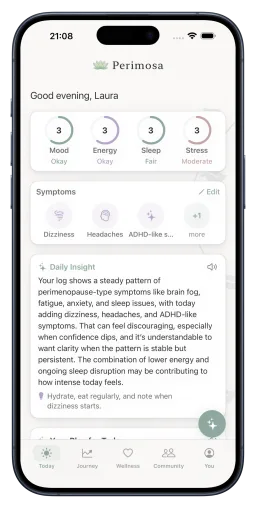
Finally understand what your body is doing
Perimosa logs how you feel each day, finds the pattern, and gives you the words to take to your doctor. Free on iPhone and iPad.
Get the free appThe Hormonal Side of Fatigue
Estrogen plays a direct role in mitochondrial function -- the cellular machinery that produces energy. As estrogen fluctuates and declines, your cells become less efficient at making ATP, the body's energy currency. Progesterone supports sleep quality, and when it drops, deep restorative sleep becomes harder. Cortisol patterns also shift, leaving many women wired-but-tired in the evening and exhausted in the morning. None of this is in your head.
Why Sleep Doesn't Fix It
A core frustration of perimenopause fatigue is that resting doesn't restore you the way it used to. Night sweats fragment sleep without you fully waking. Hot flashes interrupt deep sleep stages. The 3am wake-up pattern means you miss the sleep window where the body does most of its repair work. Even when you sleep 8 hours, the quality may be poor, leaving you with a chronic sleep debt that compounds over weeks.
Common Compounders
Several conditions silently worsen perimenopausal fatigue. Low iron is common in women with heavier periods. Vitamin D deficiency affects energy and mood. Thyroid function often shifts during perimenopause and frequently goes undiagnosed. Blood sugar swings cause afternoon crashes. Chronic stress depletes adrenal reserves. Many women treat the fatigue without realizing one of these is the major driver. A blood panel is worth requesting if fatigue is severe.
What Actually Restores Energy
Prioritize protein at every meal -- it stabilizes blood sugar and provides amino acids for energy production. Get morning sunlight to anchor your circadian rhythm. Move your body daily; counterintuitively, exercise increases energy even when you're tired. Address sleep quality before sleep quantity. Consider whether HRT might help, especially if night sweats fragment your nights. Track your energy daily so you can identify what genuinely helps versus what only seems to.
The Fatigue Pattern Worth Knowing
Perimenopausal fatigue follows recognizable patterns once you track it. Many women have the worst exhaustion in the late luteal phase (days 7-3 before a period) when estrogen drops fastest. A second pattern is the afternoon energy crash 1-3 hours after a carb-heavy lunch, a sign of perimenopausal insulin resistance. A third is the wake-tired pattern -- you slept 8 hours but feel as if you slept 4, which usually points to fragmented sleep from undiagnosed night sweats or sleep apnea. Tracking your energy at fixed times in Perimosa (morning, midday, evening) alongside sleep, cycle phase, and what you ate reveals which pattern is yours. Without this, every fatigue intervention is a guess. With it, you can target the actual driver.
Test for These Before Accepting It
Several treatable conditions silently worsen perimenopausal fatigue and get missed routinely. Request a full panel: ferritin (not just hemoglobin -- iron stores often run low long before anemia shows), vitamin D 25-OH, vitamin B12, full thyroid panel including free T3 and free T4 (TSH alone misses many cases), fasting glucose and A1c, and a celiac screen if any GI symptoms are present. Also ask about sleep apnea -- it's massively underdiagnosed in women because the typical presentation differs from men's. If your doctor only checks hemoglobin and TSH and pronounces you 'normal,' that's not a thorough workup for a perimenopausal woman with significant fatigue.
What Doesn't Fix Perimenopausal Fatigue
Many women spend years on interventions that don't address the root cause. More caffeine creates an afternoon crash and disrupts sleep, worsening tomorrow's fatigue. 'Energy drinks' and stimulant supplements deplete underlying reserves. Severe caloric restriction or low-carb crash diets often accelerate exhaustion because the body needs glucose. Pushing through with extra cardio without recovery worsens cortisol. Sleeping in on weekends disrupts circadian rhythm without truly catching up sleep debt. The pattern that fails women over and over: treating fatigue like a willpower problem rather than a biological one.
Bottom Line
Perimenopausal fatigue is biological, not a character flaw, and it responds to the right interventions in the right order. First: rule out treatable causes with thorough blood work and sleep apnea screening. Second: address sleep quality before sleep quantity (cool bedroom, no alcohol within 3 hours of bed, treating night sweats directly). Third: stabilize blood sugar with protein at every meal, especially breakfast. Fourth: strength train -- counterintuitively, building muscle restores energy more reliably than rest. Track your energy daily for 4 weeks to measure what's actually working. If foundations don't restore you within 6-8 weeks, talk to your doctor about HRT, which dramatically improves fatigue for many women when it's hormone-driven.
References
Medical disclaimer: This article is for informational purposes only and does not constitute medical advice. Always consult a qualified healthcare provider for diagnosis and treatment decisions. Perimosa is a symptom tracking tool, not a medical device.